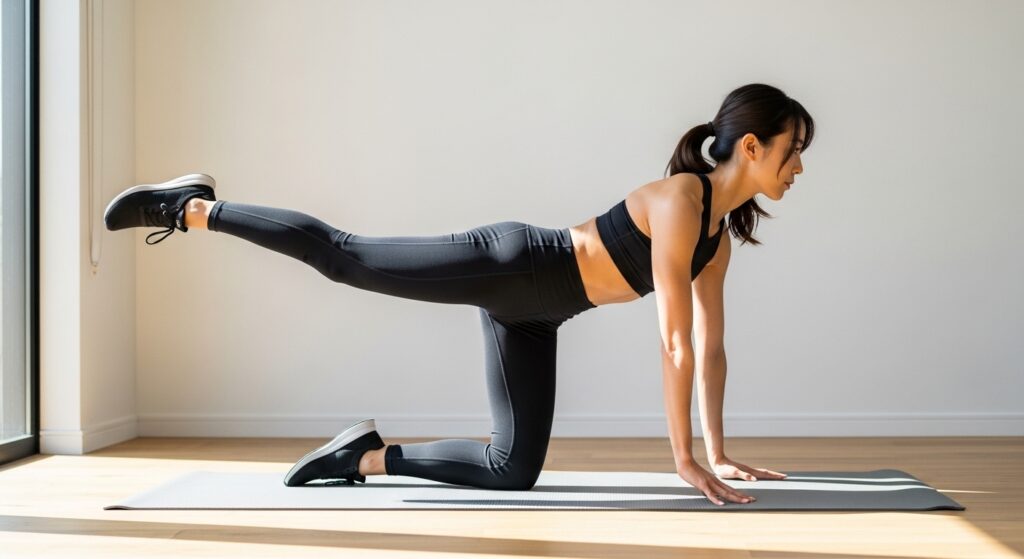
Home Workout for Perfect Glutes! Concerned About Your Hip Width?
Do you feel like your glutes have lost volume and are sagging overall?
Do you notice dips on the outer sides of your glutes when you wear jeans?
Are you concerned about pelvic misalignment or imbalances between your left and right sides?
Are you struggling with these issues despite your home workouts?
While many focus on training the gluteus maximus for overall volume, the key to achieving a sleek, beautiful hip line and stabilizing your pelvis actually lies in strengthening the outer glutes (gluteus medius).
That’s why we recommend the Fire Hydrant exercise, which requires no special equipment and can be started at home right away.
This article will explain the benefits of the Fire Hydrant, the correct form to maximize its effects, and how to dramatically improve your form accuracy using the latest AI camera app, all from a professional perspective!
The Benefits and 3 Key Effects of the Fire Hydrant Exercise for Targeting the Gluteus Medius
The Fire Hydrant is a bodyweight exercise where you lift one leg out to the side from a tabletop position. It got its unique name (like a fire hydrant) because the pose resembles a dog lifting its leg.
The primary target is the gluteus medius, located on the outer side of your hips. Stimulating this muscle offers numerous benefits for both your body line and your overall health:
1. Achieve ‘Peach Glutes’ with a Firm, Tight Appearance
Training only the gluteus maximus (the back of the hips) can lead to a squarish appearance if the sides of your hips are sunken. By effectively training the gluteus medius, you can create a plump, rounded shape on the sides of your glutes, resulting in a firm, three-dimensional, beautiful hip contour.
2. Stabilize the Pelvis and Improve Posture and Alignment
The gluteus medius plays a crucial role in supporting and stabilizing the pelvis from both sides during daily activities like walking, running, and standing on one leg. Strengthening this muscle helps correct pelvic tilt and misalignment, leading to a flatter stomach and improved standing posture.
3. Enhance Performance in Daily Activities and Prevent Injuries
A stable pelvis and hip joint reduce body sway during walking. This lessens unnecessary strain on the knees and lower back, proving effective in preventing lower back pain and knee pain.
*(Note: If you already experience severe pain in your back or knees, please consult a doctor before attempting this exercise.)*
Correct Fire Hydrant Technique and Common Mistakes to Avoid
The Fire Hydrant may seem simple, but performing it incorrectly can prevent you from effectively targeting the gluteus medius and may even lead to lower back injury. Let’s review the correct steps and precautions to prevent injuries and ensure maximum effectiveness.
Correct Technique for Enhanced Results
- Start Position: Get on your hands and knees, with your wrists directly under your shoulders and your knees directly under your hips.
- Engage Your Core: Lightly contract your abdominal muscles to keep your back straight.
- Action: Keeping your knee bent at a 90-degree angle, slowly lift one leg straight out to the side, using the muscles on the outer side of your hip.
- Hold & Control: Feel the contraction in the outer glute muscles, hold for 1 second, and slowly return to the starting position.
- Repetition Goal: Aim for 15-20 repetitions on each side, for 3 sets.
3 Common Mistakes That Hinder Form and Effectiveness
To maximize results and prevent injury, be mindful of these three common mistakes:
- Mistake 1: Rotating the Entire Body
Trying to lift the leg too high can cause your entire torso to rotate sideways. This engages your lower back muscles instead of the gluteus medius. Keep your pelvis parallel to the floor and focus on moving only your hip joint. - Mistake 2: Arching or Rounding Your Lower Back
Rounding your back or excessively arching your lower back during the movement can cause back pain. It’s crucial to engage your core and maintain a straight line from your head to your hips. - Mistake 3: Using Momentum
Lifting the leg with momentum reduces the load on the target muscles. Perform the movement with control, aiming for a 2-second lift and a 2-second lower.
Measure Hip Joint Angles and Visualize Imbalances with the AI Camera App ‘OrionFit’
Are you unsure if you’re lifting your leg at the correct angle, even though you feel like you are?
Do you suspect there’s a difference in how easily you can lift each leg, and want to confirm it?
The cutting-edge fitness app ‘OrionFit’, equipped with an AI camera, is here to solve these common home workout challenges. Using just your smartphone’s camera, it scientifically supports your Fire Hydrant exercise.
Smart Training Steps Using OrionFit
- Set Up Your Phone and Launch the Camera
Place your smartphone on a slightly elevated surface, positioned horizontally so that your entire body, especially from the waist down, is visible in the frame. - AI Camera Judges Angles & Reps
OrionFit’s AI camera feature recognizes your joint positions in real-time. It automatically determines if your hip joint is opening to the correct angle and accurately counts your repetitions.
*(Note: This feature is for motion tracking and is not intended for precise orthopedic form analysis or error detection.)* - Score Your Overall Workout Performance
Once your workout is complete, the AI provides an overall score for your session, evaluating factors like angle consistency and rep rhythm. This allows you to easily see how accurately you performed and helps maintain motivation. - Get Personalized AI Advice with the Pro Plan
For those looking to take their training to the next level, the ‘Pro Plan’ is recommended. Based on your accumulated workout data, you can receive personalized AI advice such as, ‘Your range of motion on the left side appears slightly limited,’ or ‘Your pace tends to be fast; try to maintain a consistent rhythm.’
By incorporating objective data from AI, your