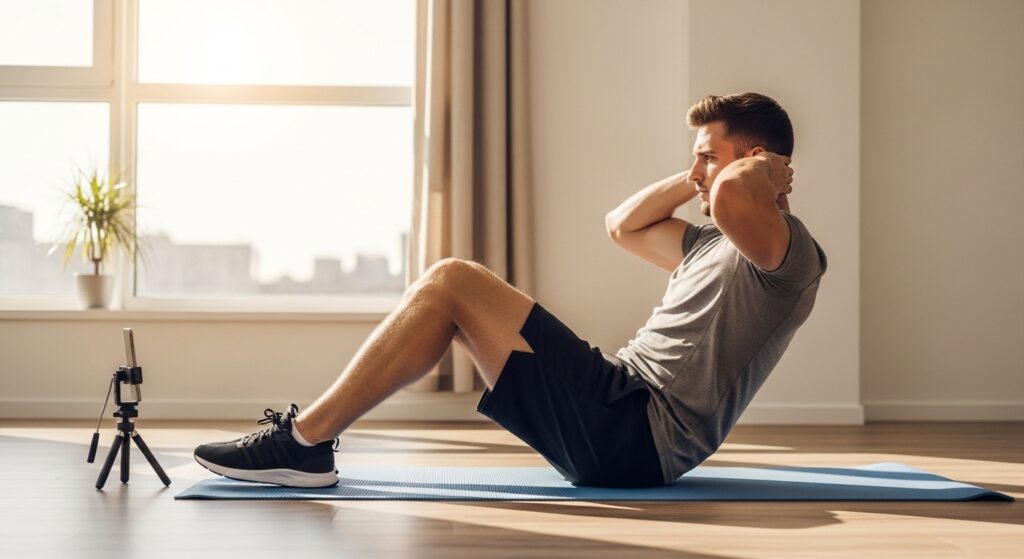
Build a Chiseled Six-Pack at Home! The Real Cause of Neck Pain During Crunches and How AI Solves It
Everyone dreams of a ripped, sculpted six-pack. Many men dedicate themselves to at-home crunches to achieve the defined abs that are a hallmark of a lean, muscular physique. However, do you face these issues during your training?
- “I’m supposed to be training my abs, but my neck and lower back hurt instead.”
- “I’m not sure if I’m really feeling it in my upper rectus abdominis.”
- “I lack confidence in my form with just bodyweight exercises at home.”
Crunches, despite their apparent simplicity, are surprisingly complex. Incorrect form not only fails to target the abs effectively but also significantly increases the risk of injuring your cervical spine (neck) or lower back.
The primary reason for neck pain during crunches is insufficient strength to lift the upper body or a lack of focus, leading you to pull your head with your hands, bending only your neck.
This not only diverts the load away from your abs but also escalates the risk of injury. This is where a scientifically sound approach to form and technology that objectively visualizes your technique become indispensable.
This article will thoroughly explain the scientific mechanism behind crunches that intensely target the upper rectus abdominis and the correct way to perform them. Furthermore, we will teach you how to achieve the ultimate, unwavering at-home ab workout by utilizing the AI camera function of the smartphone app “OrionFit,” equipped with the latest AI technology, to measure your torso-raising angle in real-time.
The Science Behind Targeting Your Upper Abs: Why Crunches Can Build Muscle Without Lower Back Pain
To efficiently bulk up or slim down, understanding muscle structure is the fastest route. Let’s explore the scientific basis of why crunches are effective for your abs.
1. The Structure of the Rectus Abdominis: Why Crunches Hit the “Upper Abs”
The “rectus abdominis,” located at the front of your torso, is a long muscle running vertically from below your chest to your pubic bone (lower pelvis). While it appears as a single large muscle, its upper and lower portions can be stimulated independently through controlled nerve signals and movement patterns.
Crunches are the most suitable exercise for specifically targeting the “upper rectus abdominis.” By initiating the movement (spinal flexion) primarily from the thoracic spine (around the mid-chest acting as a pivot point), you can directly apply intense contractile stress (mechanical tension) to the upper half of the rectus abdominis.
2. The Crucial Difference from Sit-ups (Traditional Ab Exercises)
When most people think of “ab exercises,” they imagine sit-ups, where you fix your feet and raise your upper body completely. However, sit-ups heavily engage the “hip flexors” (muscles that bend the hip) in addition to the abs.
- Sit-ups: Raising the upper body fully causes the pelvis to tilt forward, making the hip flexors the primary movers. This can pull on the lumbar spine, leading to back pain.
- Crunches: This involves curling the upper body towards the pelvis, using the mid-chest as a pivot point, while keeping the lower back pressed against the floor. By minimizing hip joint movement, you can safely isolate and train only the upper rectus abdominis.
3. Why Crunches Minimize Strain on Your Lumbar Spine?
Crunches do not involve excessive bending or lifting of the lower back off the floor. By consistently keeping the lower back pressed against or stable on the floor, dangerous shear forces on the intervertebral discs are minimized. This allows even men with lower back issues to safely push their upper abs to their limit.
The Correct Crunch Technique for Maximum Effectiveness: Optimal Angle for Shoulder Blade Lift and Forms to Avoid
To consistently target the upper rectus abdominis, millimeter-precise form control is essential. Commit the following points to memory and practice them.
【Complete Guide】Correct Crunch Setup & Execution Steps
- Starting Position: Lie on your back with your knees bent at 90 degrees and feet flat on the floor, hip-width apart. Lightly place your hands behind your ears or cross them over your chest (avoid clasping your hands behind your head, as this can lead to pulling your neck when fatigued).
- Brace Your Core (Draw-in): Before starting the movement, exhale completely, drawing your belly button towards your spine and pressing your lower back into the floor. This protects your lumbar spine and efficiently activates the rectus abdominis.
- Curl Up (Contraction): Exhale as you curl your upper body up, as if looking at your belly button, until your shoulder blades completely lift off the floor (approximately 30 degrees).
- Hold at the Top (Peak Contraction): Pause for 1 second at the point of maximum contraction (top position), squeezing your abs tightly.
- Controlled Lowering (Extension): Inhale as you slowly lower your upper body, resisting gravity. Keep your head slightly off the floor without fully resting it, maintaining tension in your abs throughout the movement.
【Injury Prevention】2 Major NG Forms to Absolutely Avoid
- NG Form ①: Neck-Crunch (Over-chin Tuck)
Your neck is bent sharply forward, with your chin pressed hard against your chest. This puts extreme stress on your cervical spine and causes neck pain, with little to no ab engagement. - NG Form ②: Momentum Crunch
Using momentum and bouncing to move your upper body up and down. This completely releases the tension from the target muscle (rectus abdominis), turning it into a pointless exercise focused only on quantity.
The Ideal Range of Motion for Maximum Upper Ab Engagement is “Approximately 30 Degrees”
The optimal angle for raising your upper body during a crunch is approximately 30 degrees from the horizontal plane.
Raising higher than this engages the hip flexors, while staying lower fails to provide sufficient contraction of the rectus abdominis. Reproducing this “30-degree” angle accurately on every rep is the absolute prerequisite for sculpting ripped abs in the shortest time.
The Smartphone App “OrionFit” Revolutionizes At-Home Ab Training! AI Camera Measures Angle & Counts Reps
The biggest obstacles in at-home self-training are “not knowing if your form is correct” and “compromises due to fatigue (form breakdown).” It’s structurally impossible to check your body’s angle in a mirror while performing crunches alone.
The latest technology to solve this challenge is the smartphone fitness app “OrionFit.”
1. AI Camera Measures the “30-Degree Upper Body Raise” in Real-Time
Simply launch OrionFit, set your phone beside you, and perform crunches. The built-in AI camera accurately recognizes your upper body’s raising angle.
- The AI instantly determines if your shoulder blades have lifted sufficiently off the floor to reach the ideal “approximate 30-degree” angle.
- Only crunches that reach the specified angle are accurately counted as “1 rep.” Cheated reps, where only your neck is bent, are not counted, enforcing a strict environment where you are compelled to work your abs correctly.
- (Note: This is a camera-based motion verification function, not a precise form analysis or error detection tool.)
2. Visualize Motivation with Workout Scoring
For crunches, the key to muscle hypertrophy isn’t just “how many reps you did,” but “how consistently you maintained correct form.” OrionFit analyzes the “angle stability” and “rep tempo” throughout your session and converts it into a score.
You can enhance your training quality dramatically and boost motivation with a game-like approach, such as “I maintained perfect form throughout the session today and scored 95 points,” or “Even as I got tired towards the end, I kept the correct angle.”
3. Get Personalized Feedback from an AI Personal Trainer with the Pro Plan
If you’re serious about achieving a lean, muscular physique, OrionFit’s Pro Plan becomes a powerful ally. Based on your accumulated workout data, the AI analyzes your training patterns and provides personalized advice.
You can receive precise guidance, as if you had a personal trainer by your side, such as “You tend to have a shallower torso-raising angle in the latter half of your set. Consider adjusting the rep count or consciously increasing the hold time at the peak contraction.” All this is available through your smartphone.
Conclusion: Transform Your Home into a Cutting-Edge Gym Today! Get Ripped Abs Scientifically with OrionFit
At-home bodyweight training, when combined with correct knowledge and the latest technology, can deliver body-building results comparable to, or even exceeding, expensive gym equipment and free weights. It’s not about blindly increasing reps with sheer willpower to achieve separated upper abs and a lean physique.
What’s essential is “correct form that prevents neck pain” and “strict, objective angle and rep counting by AI.”
Turn your smartphone into the world’s most accurate personal trainer starting today. With the OrionFit app, you no longer need to worry, “Is my form correct?” You’ll feel your rectus abdominis screaming with each rep, knowing you’re steadily progressing.
Install the app now from the link below and start your scientific, smart ab training to achieve the unwavering, powerful six-pack everyone desires!
- AI camera recognizes torso-raising angle for accurate rep counting
- Scoring system visualizes and quantifies training quality
- Pro plan offers personalized AI coaching and advice
Train scientifically, reach your ideal physique faster.