Beyond Squats: The Hip Bridge for Building a Powerful Lower Body and Core at Home
When it comes to lower body training at home, squats often come to mind. While squats are excellent for overall lower body development, are they enough? There’s a crucial target area often missed by squats alone, vital for building a powerful physique and achieving that lean, muscular look: the glutes, hamstrings, and the core that stabilizes your entire body.
The most effective at-home exercise to directly target these posterior chain muscles while minimizing stress on your lower back is the Hip Bridge (or Glute Bridge).
Many men mistakenly believe glute training is for women, but this couldn’t be further from the truth. Strong, defined glutes and an unwavering core not only enhance your silhouette in jeans but also dramatically boost performance in squats, deadlifts, and virtually all sports. It’s time to unlock the hidden potential of the hip bridge to build a formidable lower body using just your bodyweight.
The Science Behind Hip Bridges for Male Physique Transformation
Why is the hip bridge so effective for male body transformation? It comes down to the mechanics of muscle engagement and its scientific targets.
Targeting Glutes and Hamstrings Precisely
The gluteus maximus, the primary muscle of the buttocks, is the largest muscle group in the human body. Effectively training your glutes is a direct path to dramatically boosting your metabolism and building a leaner physique. While squats tend to overload the quadriceps (front of the thighs), the hip bridge focuses on the hip extension movement, which directly engages the glutes and hamstrings with maximal contraction.
Core Stability and Pelvic Alignment Synergy
During a hip bridge, your body is supported only by your feet and shoulder blades. To lift your hips while maintaining a stable pelvis in this unstable position, your core muscles (deep external rotators, transverse abdominis, erector spinae) work intensely.
This exercise corrects pelvic alignment and strengthens the core, leading to significantly more stable form during other heavy lifts like squats and deadlifts. It creates a solid foundation, preventing injuries and enhancing overall training intensity.
Mastering the Correct Hip Bridge Form to Prevent Injury and Maximize Gains
The hip bridge may seem simple, but incorrect form not only fails to target the intended muscles but can also lead to severe lower back pain. Let’s master the biomechanically sound form.
Basic Form and Movement Steps
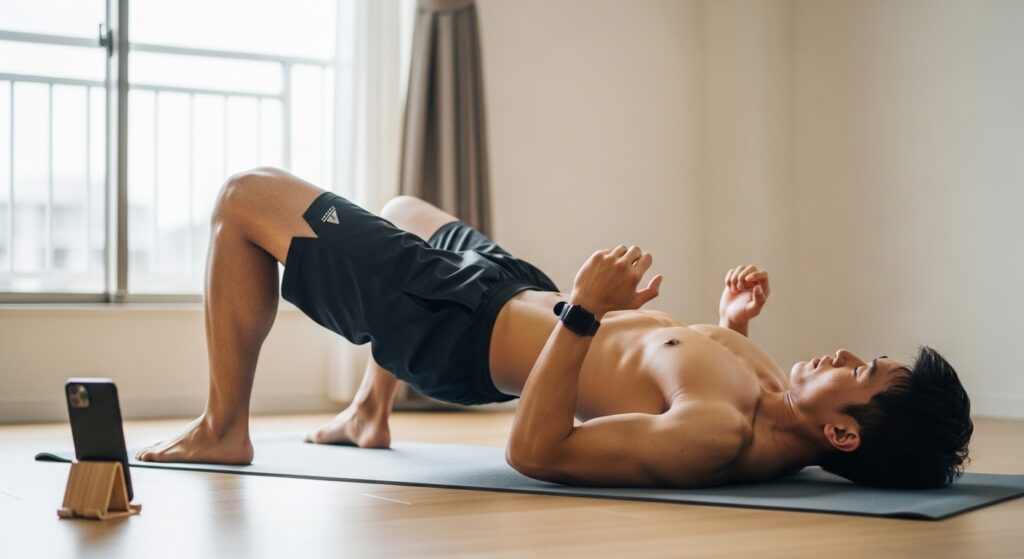
- Starting Position: Lie on your back with knees bent at approximately 90 degrees. Keep your feet shoulder-width apart, with the entire sole of your foot firmly on the ground. Let your arms rest naturally at your sides, palms facing down for stability.
- Lifting Phase (Positive Movement): Exhale and slowly lift your hips off the ground by driving through your feet, especially your heels.
- Top Position (Peak Contraction): Raise your hips until your body forms a straight line from your knees to your shoulders. At this point, squeeze your glutes intensely, as if trying to hold a coin between them.
- Lowering Phase (Negative Movement): While maintaining tension in your glutes, slowly lower your hips back down, resisting gravity. Stop just before your glutes touch the floor and transition to the next repetition.
Crucial Point to Prevent Lower Back Pain (Avoid Hyperextension)
The most common mistake is arching your lower back (hyperextending the lumbar spine) in an attempt to lift your hips higher. This not only shifts the load away from your glutes but also puts excessive strain on your lumbar spine, directly causing back pain.
The key to avoiding back arching is to slightly tilt your pelvis posteriorly (tuck your tailbone slightly, as if trying to bring your belly button towards your chest) and lift your hips using only your glute muscles. At the top position, focus on keeping your ribs down and engaging your abs, creating a rigid, plank-like core rather than arching your back.
Utilize the OrionFit App’s AI Camera for Real-Time Pelvic Angle Measurement in Your Smartphone Workout
While understanding correct form is crucial, it’s incredibly difficult to objectively assess if your pelvis is level or if your back is arching during an at-home workout. Enter OrionFit, a revolutionary app that transforms your smartphone camera into a sophisticated personal trainer.
AI Camera Turns Home Workouts into a Personal Gym Experience
OrionFit is a cutting-edge fitness app that uses your smartphone’s front camera to recognize and support your training form in real-time.
Using it is incredibly simple. Just place your phone on the floor or a stand so your entire side profile is visible, and start your hip bridges.
AI Visualizes Pelvic Angle and Movement Stability
- Rep Counting at Perfect Height: OrionFit’s AI camera detects when you reach the correct lifting angle (the ideal position where your body forms a straight line from knees to shoulders) and automatically counts a rep only when you reach it (Note: This is a camera-based motion check function, not a precise form analysis or error detection tool). This eliminates self-compromise from insufficient lifts due to fatigue, allowing you to push your glutes to their limit with every rep.
- Session Scoring: Throughout your workout, the AI analyzes angle stability, rep rhythm, and pelvic sway to score your overall session performance. Seeing your progress quantified makes it easier to stay motivated and consistent, turning your workout into a game.
Get Personalized AI Coaching with the Pro Plan
Furthermore, by upgrading to OrionFit’s Pro Plan, you can receive individualized feedback from the AI based on your accumulated workout data.
Get advice like, “Your lifting angle has been decreasing in the latter half; focus on pacing your stamina,” or “Your tempo is speeding up; consciously engage the negative (lowering) phase.” This personalized coaching, akin to having a personal trainer by your side, helps you achieve your gains safely and efficiently, even when training alone.
Conclusion: Safely and Effectively Build Your Lower Body at Home with AI Technology
The hip bridge is essential for building a strong core and powerful, defined glutes. Its intense stimulation of the posterior chain, unmatched by squats alone, is indispensable for completing that lean, muscular male physique. Maintaining the correct lifting angle and form is paramount to maximize glute activation while preventing lower back injuries.
If you’re hitting a limit with solo home workouts, it’s time to leverage technology. With the OrionFit app, the AI camera ensures your movements are correct, quantifies your efforts, and supports your progress.
There’s no need to risk back injuries with ‘guesswork’ form anymore. Why not achieve a powerful lower body and an unwavering core more safely and effectively than ever before with next-generation AI smartphone training?
Download the app now and experience the future of workouts!