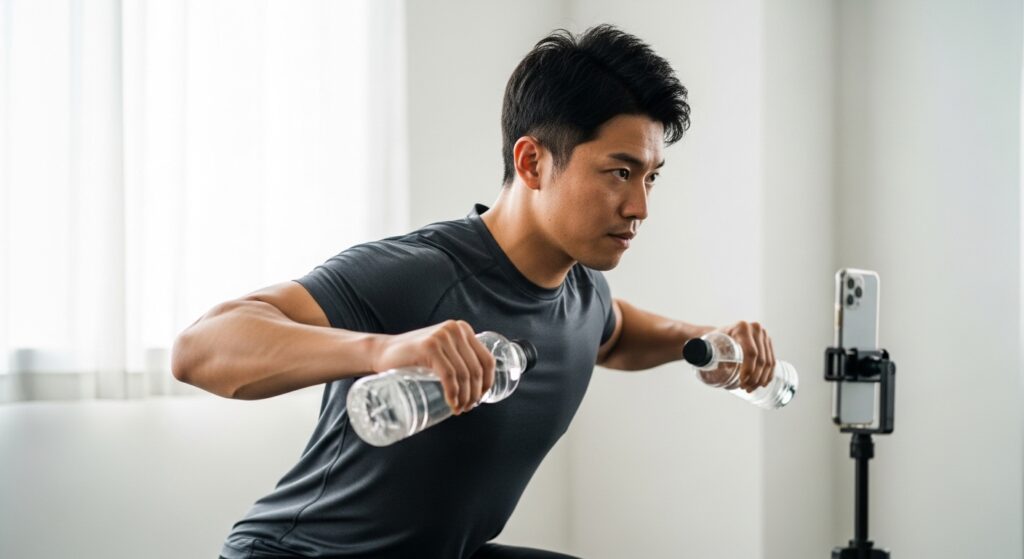
The Hidden Key to Manly Shoulders: Conquer Your Rear Delts!
Everyone wants that iconic, sculpted look of broad, ‘melon’ shoulders that turn heads. But many gym-goers unknowingly neglect a crucial muscle: the rear deltoid. Focusing only on the front and side parts of your shoulders can lead to rounded shoulders and a less impressive physique from the side and back.
Are you struggling to feel your rear delts during home workouts, or do you think it’s impossible without dumbbells? The truth is, the rear deltoid is a delicate muscle where proper form and angle are far more important than heavy weight.
This article reveals how to use simple water bottles to precisely target and demolish your rear delts with the ‘rear raise’. We’ll also introduce cutting-edge smartphone training with AI camera analysis using ‘OrionFit’ to break through your home workout limitations.
Why Your Rear Raises Aren’t Working: Common Mistakes & Injury Risks
There’s a clear scientific reason why your rear raises might be hitting your neck or back instead of your rear delts. Understanding these flaws and risks is the first step to effective training.
Anatomical Role of the Rear Deltoid
The rear deltoid is primarily responsible for moving your arm backward (shoulder’s horizontal abduction, extension, and external rotation). Being a smaller, thinner muscle, it’s not designed for heavy lifting like the chest or lats.
Mistake 1: Shrugging Your Shoulders (Engaging Traps)
The most common error is squeezing your shoulder blades together. This shifts the load to your mid-to-lower traps and rhomboids in your upper back, not your rear delts. If your neck or upper back feels fatigued, you’re likely lifting the weight with your shoulder blades.
Mistake 2: Insufficient Forward Lean
Standing too upright turns the exercise into a side raise, targeting the wrong muscles. Gravity pulls downwards, so you need a sufficient forward lean to apply direct resistance to the rear delts.
Mistake 3: Risk of Impingement from Over-Lifting
Lifting your arms too high, above shoulder level, is dangerous. It can cause shoulder impingement syndrome, where tendons get pinched, leading to pain and potential injury. This can sideline all your chest and shoulder training, so avoid it at all costs.
Dramatic Gains with Pet Bottles: Perfect Rear Raise Form
The rear deltoid is small, making 500ml to 2L water bottles a perfectly effective tool. Controlling a bottle precisely targets the muscle better than heavy dumbbells for superior gains.
Starting Position: The Perfect Lean
- Stance: Stand with feet slightly narrower than shoulder-width, holding a water bottle in each hand.
- Hinge at the Hips: Bend your knees slightly and hinge forward at your hips, keeping your back straight.
- Proper Angle: Lean forward until your torso is nearly parallel to the floor (aim for 45-75 degrees).
- Arm Setup: Let your arms hang straight down, palms facing each other or slightly inward.
Action: Lock Scapula, ‘Throw’ the Bottle Outward
- Lock Scapula: Keep your shoulder blades stable and prevent them from squeezing together.
- Arcing Motion: With a slight bend in your elbows (10-20 degrees), raise your arms out to the sides in an arc.
- Track the Path: Imagine ‘throwing’ the bottles away from you. Slightly lifting your pinky finger side towards the ceiling can enhance rear delt contraction.
- Top Pause: Pause briefly when your arms are parallel to the floor (at shoulder height).
Control: Maximize Muscle Engagement on the Descent
- Resist Gravity: Don’t just let the bottles drop.
- Slow Down: Control the descent for 2-3 seconds, feeling the tension in your rear delts.
- Maintain Tension: Just before the bottles hang straight down, reverse the motion to start the next rep.
OrionFit AI Camera: Perfect Your Form and Maximize Results
The biggest drawback of home workouts is the inability to objectively assess your form. As fatigue sets in during rear raises, common errors creep in:
- Body starts to rise to make it easier.
- Using momentum (cheating) to swing the weights up.
- Inability to lift the arms to the full height.
Eliminate these errors and train with gym-level precision at home with the ‘OrionFit’ smartphone app.
AI Camera Analyzes Your Movement: Angle Visualization
Download the OrionFit app, set up your phone, and stand in front of the camera to transform your home into a smart gym.
- Angle Recognition: The AI detects your body’s angles, verifying your forward lean and arm elevation in real-time. This provides objective feedback without needing to guess. (Note: This is a motion verification feature, not a detailed form analysis).
- Accurate Rep Counting: Cheated reps or half-reps won’t be counted. OrionFit’s AI only counts quality reps that meet the correct angle criteria, ensuring you reach true muscle failure.
Score Your Workouts for Visible Progress
OrionFit visualizes your entire workout session, automatically scoring your performance based on angle stability and rep rhythm. This gamified approach keeps you motivated as you track your progress and take confident steps towards building muscle.
Pro Plan: Personalized AI Feedback
For serious trainers, the Pro plan offers personalized advice from the AI based on your workout data. Get specific feedback like ‘Your angle tends to waver in later reps’ or ‘Maintain a more consistent rhythm’ to optimize your gains safely and efficiently.
Conclusion: Forge Your Perfect Physique with OrionFit
With the correct forward lean and stable shoulder blades, pet bottle rear raises can deliver an intense stimulus to your rear delts, surpassing even heavy gym weights. And ‘OrionFit’ is your ultimate partner in perfecting this form, turning every home workout into a professional-level session.
No more excuses about ineffective home workouts. With just a smartphone and a water bottle, your physique can transform dramatically. Download the OrionFit app now, leverage AI technology, and achieve those coveted melon shoulders and that powerful V-taper physique!