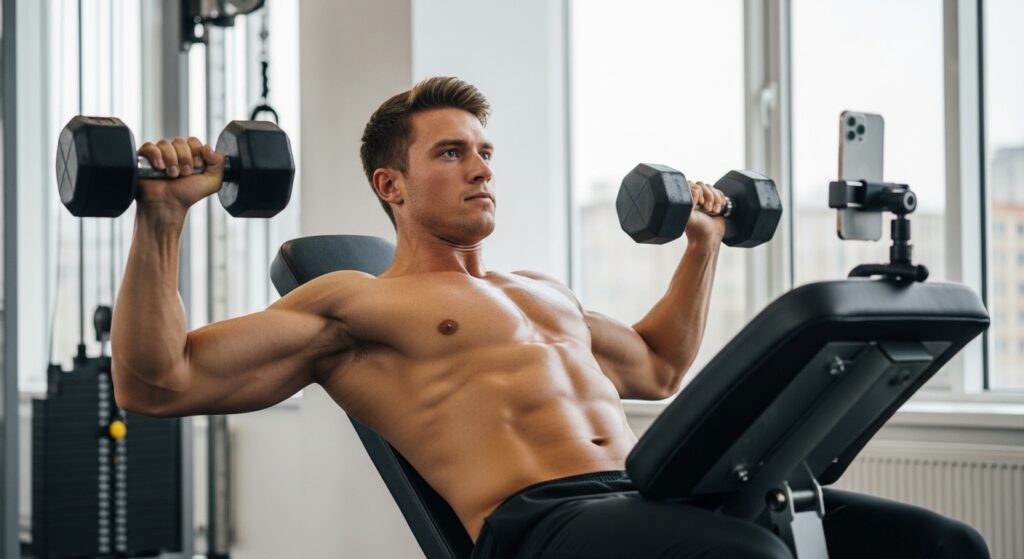
Why the Incline Dumbbell Fly is Essential: The Key to Sculpting an Impressive, Fuller Upper Chest
A thick, sculpted upper chest that fills out your t-shirt is a hallmark of a powerful physique. However, many trainees hit a plateau, finding that despite rigorous bench pressing, their upper chest remains underdeveloped, or that focusing solely on flat exercises leads to an imbalance with the lower chest appearing saggy. The solution? The Incline Dumbbell Fly, the ultimate exercise to specifically target the clavicular head of the pectoralis major, creating that coveted three-dimensional chest volume.
By performing dumbbell flies on an incline bench, you can achieve a powerful stretch (elongation) stimulus along the fibers of the upper chest. However, this exercise comes with a higher risk of injury if not performed correctly, particularly concerning the shoulders. This guide will walk you through the correct technique to maximize muscle hypertrophy while minimizing injury risk, incorporating cutting-edge form management with AI technology.
Incline Dumbbell Fly vs. Pressing Movements: The Scientific Difference in Muscle Hypertrophy Approach
Chest training often revolves around pressing movements like the bench press and incline dumbbell press. But why is incorporating a fly movement, like the incline dumbbell fly, crucial? The answer lies in the scientific principles of muscle hypertrophy.
Maximizing Stretch Stimulus with Single-Joint Isolation
Pressing movements engage the triceps and anterior deltoids, allowing you to lift heavier weights. However, as compound exercises involving multiple joints, the load can be distributed, potentially reducing the direct stimulus to the pectoralis major compared to isolation movements. The incline dumbbell fly, a single-joint exercise focusing only on the shoulder joint, significantly reduces triceps involvement, allowing for pinpoint focus on the upper chest. Crucially, at the bottom of the movement, it provides an intense stretch stimulus—unattainable with pressing exercises—that powerfully signals muscle growth.
Anatomical Approach Targeting the Upper Chest (Clavicular Head)
The pectoralis major is broadly divided into upper, middle, and lower regions, each with distinct fiber orientations. The upper chest fibers run diagonally downwards from the clavicle to the humerus. Therefore, movements that involve pressing upwards or pulling inwards from a lower position, following this diagonal line, create optimal contraction and stretching. An incline bench set between 30 to 45 degrees perfectly aligns the incline dumbbell fly with the orientation of these upper chest fibers, ensuring efficient and direct stimulation.
The Correct Incline Dumbbell Fly Technique and the Danger of Overextending Your Elbows
While highly effective, improper form can lead to shoulder injuries (rotator cuff) or strain on the biceps tendon instead of the chest. Learn the correct steps and common critical errors to avoid.
Form and Execution for Maximum Upper Chest Engagement
- Bench Angle Setting: Set the bench angle between 30 to 45 degrees. An angle steeper than 30 degrees can shift the load to the anterior deltoids. The 30-degree position (often the second or third notch) is generally optimal.
- Starting Position: Lie on the incline bench with dumbbells in hand. Plant your feet firmly on the floor for stability. Retract and depress your scapulae (pull your shoulder blades back and down, puffing your chest out). Press the dumbbells directly above your chest with palms facing each other.
- Controlled Descent (Eccentric Phase): While inhaling, open your arms in a wide arc. The dumbbells should travel not directly to the sides of your chest, but along the line extending from your collarbones.
- Turning Point at the Bottom: Feel a deep stretch in your upper chest. Without using momentum, exhale and bring the dumbbells back to the starting position as if hugging a large tree.
The Critical Error: Overextending the Elbows and How to Prevent It
The most common and dangerous mistake in dumbbell flies is lowering the dumbbells with completely straight elbows. When elbows are locked out while handling heavy weights, the lever principle exerts immense shear force on the shoulder and elbow joints, and the biceps tendon, significantly increasing the risk of injury. To correctly target the chest, maintain a slight bend in your elbows, around 100 to 120 degrees, throughout the movement. Visualize maintaining this angle, akin to hugging a large tree trunk, and focus the movement solely at the shoulder joint. This protects the joints and keeps tension focused on the pectoralis major.
Smart Training with OrionFit’s AI Camera: Accurately Managing Elbow Angle and Range of Motion
Understanding the correct form is one thing, but objectively assessing your elbow angle or stretch depth during a strenuous set is incredibly difficult. Craning your neck to check a mirror is also dangerous and strictly prohibited. This is where OrionFit, your personal AI trainer via smartphone app, comes in.
AI Camera Scores Range of Motion and Angle in Real-Time
Simply point your smartphone camera at yourself, and OrionFit’s AI recognizes your form during the workout in real-time.
- Precise Rep Counting: The AI camera detects your skeletal structure and joint positions, automatically counting repetitions only when the dumbbells reach the correct range of motion for incline dumbbell flies. This eliminates partial reps and ensures you log only high-quality sets. (Note: This feature provides automated rep counting based on motion detection and serves as a strong indicator for self-assessment, not a medical diagnosis.)
- Angle Stability Scoring: The AI analyzes the consistency of your arm opening and elbow flexion angles across each rep and the entire workout session, providing an objective score for your form consistency and rhythm.
Break Through Self-Assessment Limits and Train Safely to Failure
During solo gym sessions, maintaining form near failure can be challenging. Errors like overextending the elbows or turning the fly into a press often occur. OrionFit’s range of motion and rep counting helps you identify and correct these errors, allowing you to train safely and push your limits effectively. With the Pro Plan, you can receive personalized AI-driven advice based on your accumulated workout data, including tips on reducing form instability and suggestions for optimal weight and range of motion for future sets. It’s like having an expert personal trainer in your pocket.
Conclusion: Partner with AI Technology (OrionFit) to Achieve Your Ideal Physique Faster!
The incline dumbbell fly, key to building a full, three-dimensional upper chest, truly shines when combined with accurate knowledge and precise form. Form breakdowns can lead to injury, causing months of setback. Move beyond subjective