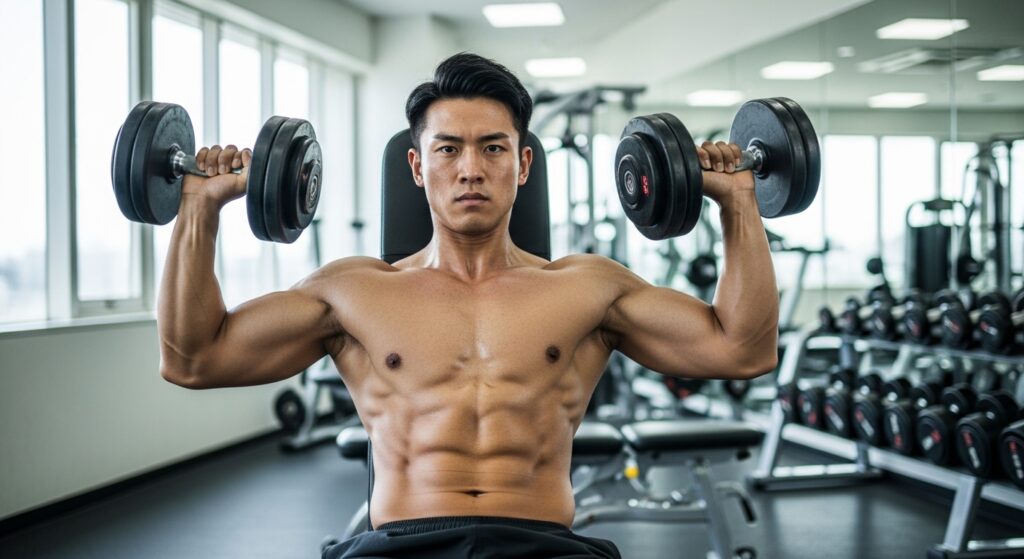
Build Your Dream “Melon Shoulders”! Why the Dumbbell Shoulder Press Reigns Supreme
When aiming for that coveted “V-taper” physique, what’s the most crucial muscle group? While many focus on the chest (pectorals) or back (lats), the true architect of your silhouette is the shoulder (deltoids). Full, rounded shoulders, like perfectly ripe melons, exude an undeniable presence even through a t-shirt, creating the visual effect of a slimmer waist and enhancing your overall V-shape.
The gold standard and most potent free-weight exercise for sculpting these “melon shoulders” is the Dumbbell Shoulder Press.
However, countless beginners struggle with this movement, often leading to injury. Common complaints include: ‘My shoulder gives out with a sharp pain during presses,’ or ‘I feel it mostly in my upper traps, not my deltoids.’ These issues are understandable; the shoulder joint boasts the greatest range of motion in the human body, making it simultaneously one of the most unstable and injury-prone joints.
Lifting heavy with poor form can severely shorten your shoulder’s lifespan. Therefore, a solid grasp of anatomical principles and meticulous form correction down to the millimeter are absolutely essential.
The Science Behind Maximum Deltoid Hypertrophy: Why Dumbbells?
Let’s delve into the scientific reasons why the Dumbbell Shoulder Press is exceptionally effective for shoulder growth.
1. Intense Stretch Under Load for Anterior and Medial Deltoids
The deltoid muscle is comprised of three heads: anterior (front), medial (side), and posterior (rear). The Dumbbell Shoulder Press primarily targets the anterior deltoid with intense mechanical stress, while also strongly engaging the medial deltoid for stabilization.
Unlike the barbell press, the independent nature of dumbbells allows for a greater range of motion, enabling you to lower the weight deeper into a stretched position. Modern sports science has proven that this load during the stretch (eccentric contraction) is a primary trigger for muscle hypertrophy.
2. Unrestricted Range of Motion and Enhanced Stabilizer Activation
Unlike machines, the dumbbell press doesn’t lock you into a fixed path. This freedom demands that not only the prime movers but also synergists and stabilizer muscles (rotator cuff) work harder to control the weight.
This not only builds deltoid mass but also develops joint stability, crucial for safely handling heavier weights. The ability to press in a natural, individual-specific path minimizes joint stress while precisely overloading the target muscles.
Maximize Your Gains, Minimize Injury: The 3 Golden Rules of Proper Form
The cardinal sin with the Dumbbell Shoulder Press is letting your form break down under heavy weight, leading to harmful friction or impingement in the shoulder joint. Internalize these three rules and apply them diligently on every rep.
Rule #1: Maintain a “Vertically Aligned Forearm”
Throughout the entire range of motion (from the bottom to the top of the press), your forearms (from elbow to wrist) must remain perpendicular to the ground (90 degrees).
As fatigue sets in, it’s common to let the elbows flare out too wide or tuck in too much. When the forearm isn’t vertical, the dumbbell’s weight exerts a rotational force on the shoulder joint, risking rotator cuff injury. Furthermore, deviation from vertical shifts the load to the triceps, diminishing the stimulus on the deltoids.
Rule #2: Set Bench to 75-80 Degrees and Focus on Elbow Position
Adjust your bench to an incline of approximately 75-80 degrees. A full 90-degree upright position increases the risk of excessive lower back arching and potential injury.
During the movement, maintain a slight chest-up posture with your shoulder blades pulled down and back (retracted and depressed). Crucially, position your elbows slightly forward of your body (about 30 degrees inward), rather than directly out to the sides. This allows you to press along the scapular plane, the shoulder’s natural range of motion, significantly reducing joint tightness and injury risk.
Rule #3: Control Your “Safe Maximum Range of Motion” to Prevent Impingement
The ideal depth for lowering the dumbbells is when the barbell shaft reaches from about your ear level down to your chin level.
Lowering further can cause your shoulder blades to impinge, narrowing the subacromial space and trapping the rotator cuff tendons. Conversely, excessively short, partial reps performed only above the head fail to provide an adequate stretch stimulus to the deltoids. Precisely executing this safe and effective maximum range of motion on every rep is paramount for hypertrophy.
【Bonus】Nutritional Strategy for Rapid “Melon Shoulder” Growth
Even with perfect form and intense training, your “melon shoulders” won’t grow without adequate fuel. Here’s the nutritional foundation for maximizing muscle growth:
- Avoid Calorie Deficits: For bulking, a slight caloric surplus (consuming more calories than you burn) is fundamental.
- Sufficient Protein Intake & Supplementation: Aim for 2.0-2.5 grams of protein per kilogram of body weight. Utilize fast-absorbing whey protein to supplement dietary intake, especially post-workout and upon waking/before bed, to maintain elevated amino acid levels.
- Don’t Fear Carbohydrates: Carbs are vital energy sources for training. Adequate carb intake prevents muscle breakdown (catabolism) and promotes insulin release, efficiently transporting amino acids to muscles.
Revolutionize Your Form with the AI Camera App “OrionFit”! Precision Shoulder Training with Just Your Smartphone
Understanding perfect form is one thing, but executing it perfectly with heavy dumbbells is another. When fatigued, it’s nearly impossible to self-diagnose issues like forearm drift or limited range of motion, and mirrors only offer limited visual feedback.
This is where the advanced AI smart training app, “OrionFit”, shines.
AI Camera Guides Your Forearm Verticality and Range of Motion
OrionFit uses your smartphone’s camera to analyze your movements in real-time.
- Precise Rep Counting: The AI detects your skeletal structure and accurately determines if you’ve reached the set range of motion and angles. It automatically counts reps only when a full, proper repetition is completed, eliminating self-leniency and maximizing the quality of every single rep.
- Workout Scoring: Throughout your session, the AI analyzes tempo, forearm stability, and range of motion consistency, providing an instant score. Visualizing your forearm’s adherence to verticality helps you gamify your progress and perfect your form.
Upgrade Your Gym Session with Just Your Phone
Without the need for expensive personal training, simply set up your phone in the gym’s free weight area. OrionFit creates an exceptionally safe and high-quality training environment, as if a personal coach were right beside you, measuring joint angles.
Conclusion: Achieve Your Ideal V-Taper Physique Faster with OrionFit!
To achieve the ultimate “melon shoulders” and build a powerful, masculine V-taper physique, success hinges on consistently performing the heavy dumbbell shoulder press with correct form and high intensity.
End the era of risky, guesswork-driven hard work. It’s time to build muscle smarter, safer, and more scientifically with the power of cutting-edge technology.
The smart training app “OrionFit” fully supports your training with high-precision AI rep counting and scoring. Upgrading to the Pro plan even provides personalized AI-driven advice based on your accumulated workout data. Receive tailored feedback on specific form corrections for forearm stability, or step-by-step guidance for appropriate weight progression based on your strength gains, powerfully backing your physique transformation journey.
To prevent injuries and unlock 120% of your deltoids’ potential, download the app now and make “OrionFit” your ultimate training partner starting with your next shoulder workout!