Why Do Deadlifts Cause Back Pain? Master the Correct Form for Maximum Bulk-Up
For trainees aiming for muscle hypertrophy and an impressively built physique, the barbell deadlift is an indispensable and powerful exercise. However, it’s also notoriously known as a high-risk movement that can easily lead to back injuries. Why do so many lifters injure their backs performing deadlifts?
The primary culprits are lifting with a rounded back (cat-back posture) due to struggling with the weight, and the failure to engage the crucial hip hinge movement, which should be the primary driver of the lift.
Avoiding the deadlift out of fear of injury is akin to discarding a prime opportunity for muscle growth. By completely mastering the correct form, you can minimize stress on your lower back while unleashing 120% of your body’s dormant potential. This article provides a scientific approach and cutting-edge smart training techniques using technology to help you build a massive back and powerful lower body in the fastest way possible.
Summoning Your Entire Back and Lower Body: Why the “Floor-Pull” Deadlift Reigns Supreme for Muscle Growth and Testosterone Production
Among all weight training exercises, the “floor-pull” deadlift—lifting a barbell off the floor—stands at the pinnacle for muscle hypertrophy. Its overwhelming effectiveness is backed by clear scientific reasoning.
Target Muscles: Devastatingly Stimulate the Entire Posterior Chain
The deadlift is called a “full-body exercise” because it engages the large muscle groups of the posterior chain simultaneously and with extremely heavy loads.
- Entire Back (Lats, Traps, Erector Spinae): The erector spinae muscles work at full capacity to maintain posture and hold the contraction at the top, creating a thick, masculine back.
- Lower Body (Glutes, Hamstrings): The powerhouse for driving off the floor. Your glutes and hamstrings generate explosive power.
- Core (Abs, Obliques, Inner Muscles): By creating immense intra-abdominal pressure, it forms a natural corset, intensely training your core to withstand heavy loads.
Scientific Mechanism: Explosively Triggering Potent Anabolic Hormone Release
The deadlift is a compound movement involving multiple joints and muscles. The sheer volume of muscles engaged, far exceeding other exercises, strongly stimulates the pituitary gland and testes, dramatically boosting the secretion of anabolic hormones like testosterone and growth hormone.
This enhances muscle protein synthesis not only in the targeted areas but throughout the entire body, powerfully supporting efficient bulking (weight gain). It is truly an essential exercise for “getting big fast.”
Synergy with Diet and Nutrition: Bulking Meals to Maximize Hormone Output
To maximize the effects of the anabolic hormones stimulated by the deadlift, the timing and quality of nutrient intake are critical. Consuming “bulking meals” rich in sufficient carbohydrates (energy source) and high-quality protein after your workout, along with post-workout protein intake, helps your muscles rebuild stronger and thicker than before. Aim for a calorie surplus exceeding your daily expenditure to ensure the hard training effects are converted into muscle.
The Correct Start Position and Basic Lifting Form to Prevent Injury and Push Your Limits
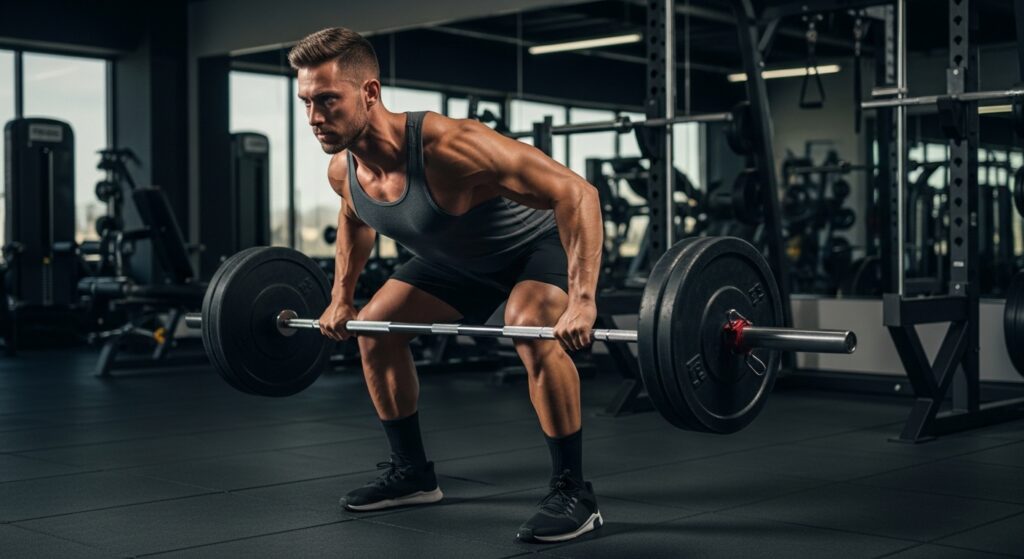
To prevent lower back pain during deadlifts and precisely target the intended muscles, meticulous attention to form, down to the millimeter, is essential. Engrave the following steps into your mind.
1. Start Position: Creating Unity Between Barbell and Body
The success of the entire lift hinges on the “setup” before pulling the bar.
- Stance Width and Bar Placement: Stand with your feet hip-width apart. Position the barbell so it’s directly over the middle of your foot (shoelace level). The distance between the bar and your shins should be about two fingers’ width.
- Hinge (Push Hips Back): Keeping your back straight, hinge strongly at the hips, pushing them backward, and lean your torso forward.
- Grip and Chest Activation: Grip the bar with your hands directly below your shoulders. Gently pull your shoulder blades down and slightly back, puffing out your chest to create tension in your lats. At this point, bend your knees just enough so your shins are lightly touching the bar, ensuring your lower back is absolutely not rounded.
2. From First Pull to Lockout: Lift by Pushing the Ground
Discard the idea of “pulling” the barbell with your hands.
- Drive Through the Floor: For the initial movement (first pull), focus on pushing the ground away powerfully with the soles of your feet.
- Straight Bar Path: The barbell must travel extremely close to your body, along your shins and thighs. If the bar drifts away from you, the lever effect will place catastrophic stress on your lower back.
- Lockout (Finish): Once the bar passes your knees, drive your hips forward (hip drive) to stand up straight. Hyperextending your upper body backward is strictly forbidden as it’s a direct cause of back pain. Squeeze your glutes hard and hold the upright position.
3. Eccentric (Lowering): Hinge Back and Slide
The lowering phase (eccentric) is just as important as the lifting phase.
- Initiate with Hips: Instead of bending your knees, first push your hips back to lower your torso. Keep knee flexion minimal until the bar passes your knees.
- Controlled Descent: Control the barbell down to the floor, absorbing its weight with your glutes and hamstrings. Maintain intra-abdominal pressure throughout and keep your back flat.
Leverage OrionFit App’s AI Camera for Real-Time Back Rounding Detection and Precise Hip Hinge Angle Measurement for Safe Training
Even with a thorough understanding of the form, your technique can falter when pushing near your limits with heavy weights. A gym mirror alone cannot provide accurate, real-time feedback on critical aspects like back rounding or hip flexion angles during maximal efforts.
Introducing the cutting-edge fitness app, “OrionFit”, which transforms your smartphone into the ultimate digital coach.
Break Through Self-Taught Form Limitations with AI at Home or the Gym
OrionFit’s standout feature is its advanced AI recognition technology using your smartphone’s camera. Simply set up your phone and perform your workout, and the AI camera will detect and analyze your skeletal structure in real-time.
- Visualize Back Rounding: Detects spinal flexion (back rounding), the highest risk factor for injury in deadlifts. It allows you to visually check if you’re deviating from the ideal spinal alignment.
- Measure Hip Hinge Angle: Visually confirms if your hips are hinged sufficiently and knees aren’t extending too far forward, assessing the correct hip flexion angle through the camera.
With “OrionFit” as your partner, you can confidently lift at your limit with minimized injury risk.
Summary: Harness Smart Tracking and AI Guidance to Forge an Impressive Back and Lower Body with Deadlifts
The “barbell deadlift” is your strongest weapon for sculpting a masculine physique and achieving extreme muscle growth when performed correctly. Instead of avoiding this exercise due to fear of back pain, let’s build a massive back and powerful lower body safely and hyper-efficiently by incorporating correct form, proper hip hinging, and real-time self-feedback through the latest technology.
Smart tracking and objective form analysis are the fastest routes to muscle hypertrophy.
Take Your Training to the Next Level with the OrionFit App!
As your partner in scientifically supporting daily workouts and accelerating your muscle growth, implement the OrionFit app today.
- AI Camera Rep Counting: The AI camera recognizes if the required joint angles are met, providing accurate rep counts (Note: This feature is for visual confirmation via the camera and does not provide precise form analysis or error detection).
- Overall Session Scoring: Analyzes the stability of joint angles during your workout and the rhythm of each rep to provide an overall workout score, allowing you to tangibly see your progress.
- AI Personalized Advice in Pro Plan: Based on your accumulated workout data, receive personalized advice optimized for you from the AI, clarifying the focus points for your next training session.
End the days of fearing injury. Team up with cutting-edge AI technology to safely break your personal bests and achieve a commanding presence with your back and lower body!