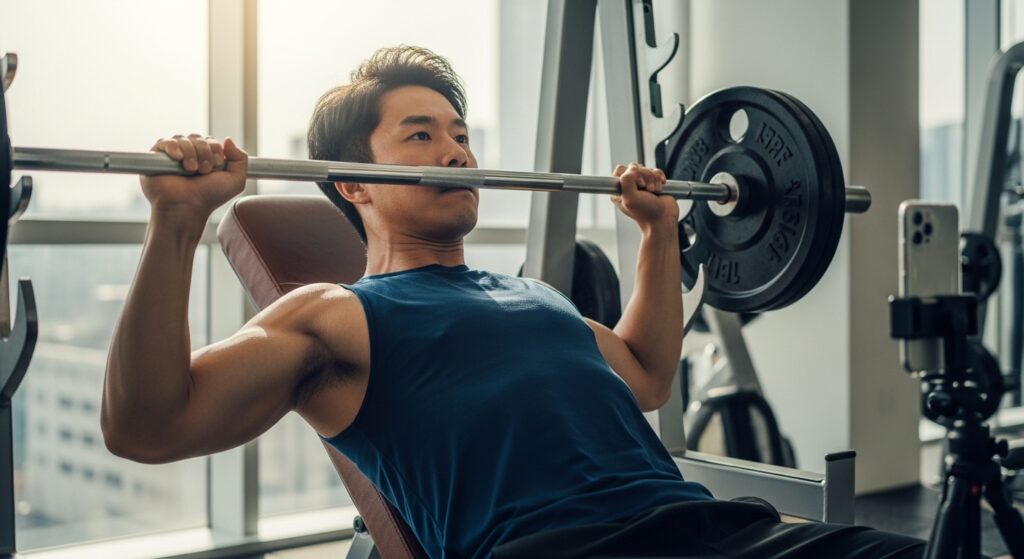
Forge an Impressive Chest: Why Upper Chest Development is Key
Imagine rocking a t-shirt with a sculpted chest that commands attention, or exuding undeniable presence in a suit thanks to powerful pectoral muscles. Many men diligently hit the bench press at the gym, striving for that coveted ‘thick chest’ that signifies masculinity. However, are you frustrated by a lack of chest definition despite serious dedication to the bench press? Do you find that your lower chest develops excessively, leaving the area below your collarbones flat and underwhelming?
The culprit is often insufficient volume in the upper chest (clavicular head). The pectoralis major is broadly divided into three sections: the upper (clavicular), middle (sternal), and lower (abdominal). Standard flat bench presses primarily target the middle and lower portions. To achieve a truly three-dimensional, balanced physique with impressive mass (muscle volume) that spills from your collarbones, you must specifically train the upper region – the apex of your chest.
This is where the Incline Barbell Bench Press becomes essential.
This article will provide a scientific approach to maximizing upper chest hypertrophy, cover the correct form, and introduce cutting-edge smartphone training techniques using AI camera technology to prevent injury and dramatically boost your workout efficiency.
Why ‘Incline’? The Scientific Advantage for Targeting the Upper Chest
To effectively build mass in your upper chest, understanding its anatomy and the mechanics of resistance is crucial. A science-based approach is the fastest roadmap to your ideal chest.
The Anatomy and Function of the Clavicular Head
The upper chest originates from the inner half of the clavicle and runs diagonally downward to the humerus (upper arm bone). Its primary function is to push the arm forward and upward (shoulder flexion and horizontal adduction). While the flat bench press applies resistance perpendicular to the floor, aligning with the middle chest fibers, performing the press with your upper body inclined aligns the resistance vector perfectly with the fibers of the upper chest.
EMG Data Confirms the Power of Incline Training
Numerous sports science and biomechanics studies have demonstrated that inclining the bench significantly increases the activation of the upper chest fibers. By setting the appropriate incline angle, you can achieve over 30% more stimulus to the clavicular head compared to a flat bench press.
Well-developed upper chest volume lifts the overall contour of your chest, enhancing the visual impression of mass and creating an attractive ‘V-taper’ silhouette that makes your waist appear slimmer. Scientifically, making the incline variation a cornerstone of your chest training is the optimal choice for building a masculine and aesthetically pleasing physique.
Preventing Injury and Pushing Limits: The Golden Rules for Correct Form and Angle
While the incline barbell bench press offers immense benefits, it can place greater stress on the shoulder joint (rotator cuff) than the flat variation. Improper form can lead to the load shifting to the anterior deltoids (front shoulders) instead of the target upper chest, potentially causing shoulder injuries. Master these four golden rules for safe and effective hypertrophy:
① Seat Angle: The Sweet Spot is ’30 to 45 Degrees’
An excessively steep bench angle shifts the load from the pectoralis major to the anterior deltoids (shoulders). It’s crucial to minimize shoulder involvement and focus the stimulus on the upper chest.
- Recommended Angle: 30 to 45 degrees
- Generally, around 30 degrees provides the optimal stimulus for the upper chest. Start at 30 degrees and adjust based on your individual anatomy and muscle activation (contraction and stretch).
② Grip Width: Forearms ‘Perpendicular’ to the Floor
The width of your grip on the bar is critical for efficient load transfer to the chest and joint protection.
- Grip the bar so that your forearms are perpendicular to the floor at the bottom of the movement (chest level).
- A good starting point is approximately 1.5 times shoulder-width. Wider grips can strain shoulder ligaments, while narrower grips shift the emphasis to the triceps.
③ Bar Descent Point: ‘Midway’ Between Clavicle and Nipple
Unlike the flat bench press where you lower the bar to your sternum, the incline press path is different.
- Slowly and controllably lower the bar (focusing on eccentric contraction) towards a point a finger or two below your clavicle (directly above the upper chest).
- Avoid flaring your elbows excessively, which can injure your shoulder joint. Maintain an elbow tuck of approximately 60 to 75 degrees and control the movement through a natural path.
④ Basic Posture: ‘Depress and Retract’ Scapula with an Arch
Once settled on the bench, strongly focus on retracting and depressing your scapula (pulling shoulder blades down and back).
- Excessive arching of the lower back (creating too high a bridge) can negate the incline angle, making it similar to a flat bench press.
- Maintain a natural arch, allowing only about a hand’s width between your lower back and the bench, and keep your shoulders firmly planted. This prevents your shoulders from rolling forward, allowing for a safe and maximum stretch of the upper chest.
OrionFit’s AI Camera Assists: Measure Your Bar Path and Forearm Angle with Your Smartphone for Form Improvement
Even with a clear understanding of the incline barbell bench press and proper technique, objectively checking your bar path and forearm angle during a strenuous set is incredibly difficult. Form often deteriorates, especially when pushing close to your limits with heavy weight (overload).
Enter OrionFit, a cutting-edge fitness app designed to transform your smartphone into a powerful personal trainer.
Your Smartphone’s AI Camera Visualizes Form Deviations in Real-Time
Simply set up your smartphone near the power rack or bench, launch OrionFit, and start your exercise. The AI instantly detects your skeletal structure and barbell movement, providing visual feedback on your screen to ensure your arm movements and bar path remain stable relative to your set incline angle.
- Real-time Analysis with AI Camera
- The AI analyzes your skeletal structure and the barbell’s motion in real-time, letting you visually confirm if your arm movements and bar path are deviating from the set incline angle.
- Accurate Rep Counting and Range of Motion Check
- The AI camera automatically recognizes when the barbell reaches the correct depth and joint angles for rep counting (※). Eliminate compromises and ambiguity about whether a rep was ‘half-rep’ or insufficient, ensuring only high-quality training is accurately recorded.
- Visualize Progress with Session Scoring
- The app analyzes the stability of your bar path, rep rhythm, and angle consistency throughout your workout, providing a ‘score’ for your session. Aiming to improve your score gamifies the process, naturally ingraining safe and effective form.
- Enhanced Progress with Pro Plan AI Coaching
- With OrionFit’s Pro plan, receive personalized AI-driven advice based on your accumulated workout data. Receive specific feedback like, “You tend to lose forearm angle on the latter half of the set” or “Maintaining a consistent upward speed can further increase the load on your upper chest.” This provides an experience akin to having a dedicated personal trainer by your side.
※ The AI camera feature in this app is a training aid and form verification tool that recognizes specific angles and range of motion for rep counting. It is not intended for precise medical or scientific-level form analysis or error detection.
Conclusion: Partner with OrionFit, Train Your Upper Chest, and Achieve a Muscular, Defined Physique
The incline barbell bench press, directly targeting the upper chest, is an indispensable exercise for building a masculine, three-dimensional chest that makes a statement even through clothing. Achieving consistent, precise training requires objective data and feedback.
It’s time to end guesswork and injury-prone training. Download the OrionFit app, turn your smartphone camera into the ultimate personal trainer, and start maximizing your upper chest growth while preventing injuries. Take your next step at the gym today!