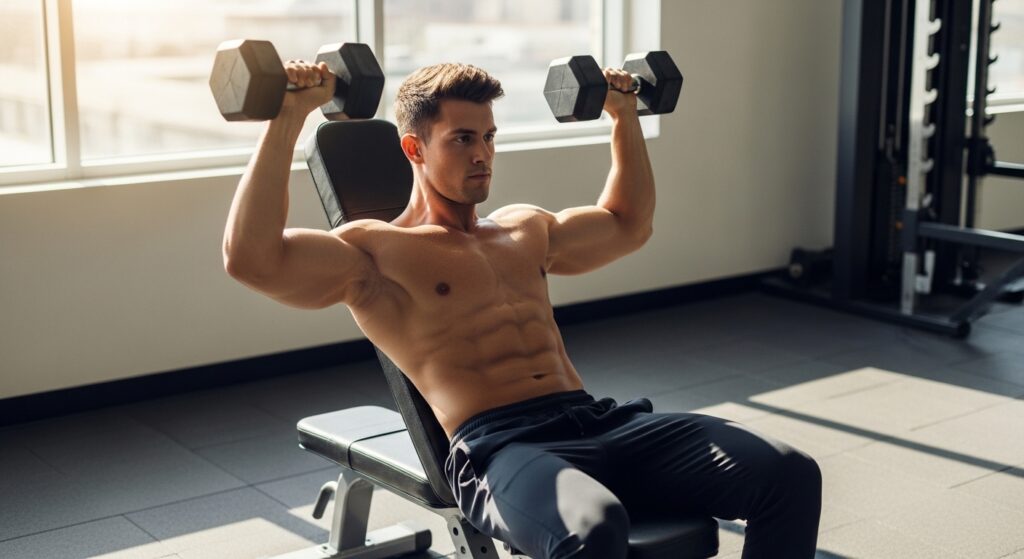
The dumbbell pullover is a legendary exercise that can simultaneously and intensely stimulate two of the most important muscle groups for male physique: the thick chest muscles and the wide back muscles that create a V-taper.
The Undeniable Power of the Dumbbell Pullover and the Challenge of Proper Form
The dumbbell pullover is a legendary exercise capable of simultaneously and intensely stimulating two of the most crucial muscle groups for a powerful male physique: the ‘thick chest muscles’ and the ‘wide back (lats)’ that define a V-taper silhouette. This exercise, heavily endorsed by legendary bodybuilders of the Golden Era, like Arnold Schwarzenegger, who called it essential for expanding the rib cage and doubling upper body thickness, is truly the ultimate shortcut for any trainee aiming for efficient muscle growth.
However, the dumbbell pullover harbors a significant pitfall: ‘maintaining the correct form is extremely difficult.’ Many trainees give up because they can’t feel the targeted muscles, experience sharp pain in their shoulders during the movement, or excessively bend their elbows, turning it into a triceps exercise. The shoulder joint is complex and delicate, and incorrect form or excessive range of motion can lead to impingement and long-term injury.
This article will scientifically explore why the dumbbell pullover is so effective for muscle hypertrophy and provide a thorough explanation of the perfect form that absolutely prevents shoulder pain. We will also introduce a cutting-edge training approach using smartphone AI technology to measure ‘elbow angle’ and ‘movement trajectory’ in real-time, allowing you to train safely to your absolute limit.
Why the Dumbbell Pullover Ignites Muscle Hypertrophy: The Science Behind Simultaneously Tearing Through Chest and Lats
What sets the dumbbell pullover apart from other exercises is that ‘maximum load is applied when the muscles are maximally stretched.’
1. Stretch-Shortening Cycle and Muscle Hypertrophy Mechanisms
Recent sports science has proven that the ‘eccentric contraction’ (when muscles lengthen under load), particularly the load at the maximally stretched position (bottom position), is the most potent trigger for muscle hypertrophy (growth). The dumbbell pullover intensely stretches the chest and lats at the bottom position, where the dumbbell is lowered behind the head. This moment experiences the greatest gravitational load, efficiently tearing muscle fibers and promoting explosive growth through supercompensation.
(Note: To effectively repair these torn muscle fibers and achieve maximum growth, prompt protein intake immediately after training and sufficient calorie and carbohydrate intake during a bulking phase are essential. Training and nutrition should always be considered together.)
2. Chest and Lats: Why Opposing Muscles Work Together
How can opposing muscles like the chest (pectorals) and back (lats) be trained simultaneously? The secret lies in the ‘shoulder joint’s range of motion.’
- Pectorals (especially upper to mid): Actively recruited during shoulder joint flexion to extension and adduction, moving the arms from overhead to the front.
- Lats: Similarly, the primary movers for shoulder extension and adduction, pulling the arms down from overhead.
Both muscle groups work in coordination for the same vector – pulling the arms down from overhead. This allows for an incredible time efficiency, simultaneously targeting both chest thickness and back width.
Prevent Shoulder Injury: Correct Dumbbell Pullover Form and What to Avoid
To fully benefit from the dumbbell pullover and eliminate injury risk, precise form is crucial. Follow these steps rigorously to ingrain the correct movement into your mind and muscles.
The 5 Steps to a Correct Dumbbell Pullover
- Bench Setup: Lie supine on a flat bench, with your head either slightly off the edge or comfortably positioned. Plant your feet firmly on the floor for lower body stability and brace your core.
(Advanced trainees may perform this as a ‘cross-bench’ pullover, but starting with a standard supine position is strongly recommended for core stability.) - Grip Creation: Place the palms of your hands on the underside of one of the dumbbell’s weight plates, forming a diamond shape with your thumbs and index fingers. The dumbbell’s shaft should pass between your palms.
- Starting Position: Set the dumbbell directly above your chest, pushing it towards the ceiling. Crucially, keep your elbows slightly bent (about 10-15 degrees) and fully locked in this position – do not straighten them completely.
- Controlled Descent (Eccentric Contraction): Inhale deeply while slowly lowering the dumbbell behind your head, using only your shoulder joint as the pivot point. Maintain the 10-15 degree elbow bend rigidly. Lower for about 3 seconds, feeling an intense stretch in your chest and lats.
- Pull Up with Chest and Back (Concentric Contraction): Exhale and, without changing the elbow angle, focus on contracting your chest and back muscles to pull the dumbbell back to the starting position directly above your chest. Squeezing your chest as the dumbbell passes your eye line towards your forehead is effective.
[Movement Trajectory Image]
[Start] Directly above chest
│ (Maintaining elbow angle)
▼
[Bottom] Behind head (maximum stretch)
3 Major Mistakes to Avoid and Causes of Shoulder Pain
- Mistake 1: Excessive Elbow Bend During Movement (Turning it into a French Press): If your elbows bend too much as you lower the dumbbell, the load shifts from your chest and lats to your triceps. This turns it into a French press, negating the goal of chest and back hypertrophy. The ‘absolute rule is to maintain the same elbow angle from start to finish.’
- Mistake 2: Lowering Too Far Beyond Shoulder’s Range of Motion: The idea that ‘deeper is better’ is a major misconception. Lowering the dumbbell too far beyond your shoulder’s and scapula’s range of motion can pinch the rotator cuff tendons or labrum, causing severe pain. Use the dumbbell reaching bench height or beside your ears as a limit, and control the movement within a safe range.
- Mistake 3: Excessive Lower Back Arching (Bridging): Trying to compensate for shoulder stiffness by excessively arching your lower back can put immense strain on your lumbar spine, leading to injuries like herniated discs. Maintain core bracing and imagine pressing your back and hips into the bench (maintaining a neutral spine).
OrionFit’s AI Camera: Real-Time Elbow Angle and Range of Motion Measurement for Safe Limit Breaking
When training alone at home or the gym, do you worry, ‘Was my elbow angle fixed correctly on that rep?’ or ‘Did I lower it too deep, putting stress on my shoulder?’ Trying to check your form in a mirror strains your neck, and filming yourself with your phone to review later is cumbersome.
This is where ‘OrionFit,’ an app that transforms your smartphone camera into the ultimate personal trainer, comes in.
Accurate Reps with AI Angle Measurement
Simply set up your smartphone camera horizontally and perform your workout. OrionFit’s AI recognizes your skeletal structure (joint positions) in real-time. It instantly detects the crucial ‘elbow bend angle (maintaining 10-15 degrees)’ and ‘dumbbell lowering trajectory range of motion’ for the dumbbell pullover. It judges whether the movement was within the appropriate range and automatically counts reps only for correct form. This strictly eliminates ‘compromise reps’ where elbows bend due to fatigue and ‘wasted reps’ that are too shallow, supporting true limit-breaking by ensuring both safety and effectiveness.
(Note: This feature uses AI camera motion detection for confirmation and is not a precise medical form analysis tool or advanced error detection system, but it dramatically improves self-check accuracy.)
Scoring Your Workout with Stable Rhythm and Range of Motion
After your workout, OrionFit analyzes your entire session, scoring and visualizing ‘whether your joint range of motion was consistent across reps’ and ‘if your lifting speed rhythm was steady.’ You’ll receive feedback like ‘Score 85: Elbow movement and rhythm became unstable in the latter half,’ allowing you to improve form accuracy game-style and connect it to steady muscle growth.
Get Your Own AI Advice with the Pro Plan
Furthermore, by utilizing the app’s ‘Pro Plan,’ you can receive personalized AI advice based on your accumulated training data. Get professional-level guidance (training and nutrition) like, ‘Your range of motion has increased over the last 3 sessions. Increase the dumbbell weight by 2kg to enhance stimulation of the upper chest. Also, consume protein and carbohydrates within 30 minutes post-workout to maximize supercompensation,’ all from your smartphone.
Conclusion: Build Your Ideal Physique Safely and Scientifically with OrionFit
When performed correctly, the dumbbell pullover is the most cost-effective (time-efficient) exercise for simultaneously achieving a ‘thick chest’ and ‘wide back.’ However, it’s also a double-edged sword that can injure your shoulder if done incorrectly.
Therefore, stop mindlessly swinging heavy dumbbells. Understand the scientific principles of correct form and leverage cutting-edge AI technology to push your limits in the safest and most efficient way possible. This is the modern, smart trainee’s path to bulking.
Install OrionFit on your smartphone tonight and experience dramatic improvements in your chest and back workout starting now.
Download the app now from the link below and build the enviable, massive upper body everyone desires, alongside AI!
[Download the OrionFit App for Free Now](Download OrionFit for free on Google Play) target=”_blank” rel=”noopener”