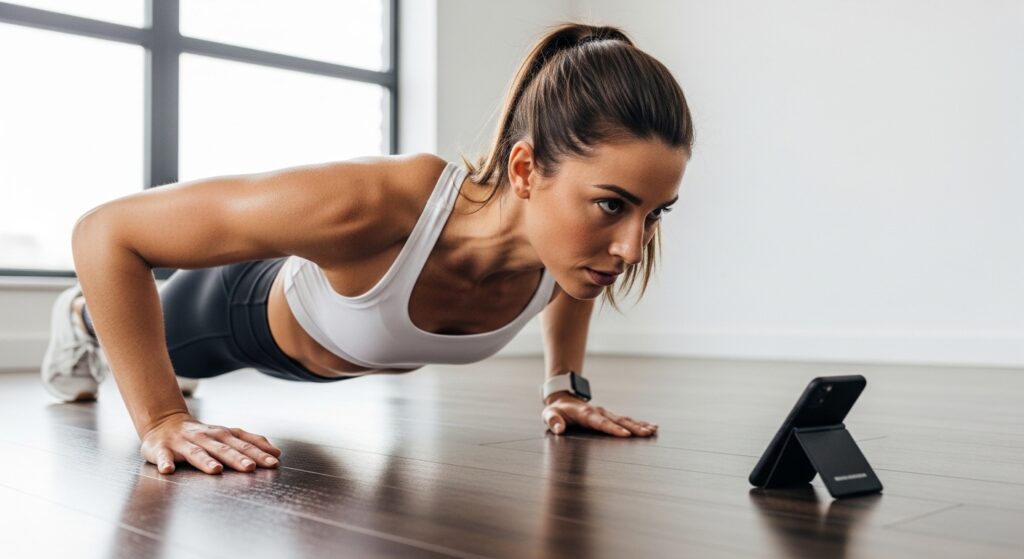
Think Push-Ups Are Easy? Beware of Common Mistakes!
When asked about simple home exercises, many immediately think of push-ups. As a fundamental bodyweight exercise, they’re fantastic for building chest and arm strength without equipment. However, because they’re so common, many people perform them with incorrect form, leading to:
- Sagging hips or raised bottoms
- Elbows flaring out, straining shoulders and wrists
- Shallow movements focused only on quantity, not quality
These “just do it” approaches not only halve your training effectiveness but can also cause serious shoulder, wrist, or back injuries. It’s counterproductive to strive for fitness only to get hurt. If you experience pain during or after training, stop and consult a medical professional.
This article will guide you through the correct push-up form to maximize your bodyweight training potential, helping you achieve a stronger chest and a tighter core efficiently and safely. We’ll even introduce the latest AI fitness technology that turns your smartphone into a personal trainer!
The Incredible Benefits of Push-Ups: Why They’re the Best Bodyweight Exercise
Push-ups are more than just a chest exercise; they engage your whole body, offering amazing benefits for a total body transformation:
Develop a Powerful Chest and Toned Arms: Targeting the Pectorals and Triceps
The primary muscles worked are the pectorals (chest muscles). Strengthening them leads to a broader chest for men and improved bust shape for women. Additionally, the triceps (back of the arms) and the anterior deltoids (shoulders) are heavily engaged, dramatically sculpting your upper body.
Build Your “Natural Corset”: Simultaneously Train Your Core
Maintaining a straight line from head to heels while engaging your abs and glutes during a push-up is essentially a plank. This means you’re simultaneously strengthening your core muscles while working your chest, leading to better posture and a flatter stomach.
No Equipment Needed: Turn Your Home into a Premium Workout Space
Forget expensive machines! With just a small space, you can start training immediately for free. Push-ups are incredibly convenient for fitting effective workouts into your busy schedule.
Maximize Results and Prevent Injury: 3 Key Push-Up Techniques
Master the fundamentals to get the most out of your push-ups safely. Focus on these three points: hand placement, elbow angle, and core engagement with breathing.
1. Hand Placement and Width: 1.5 Times Shoulder-Width, Aligned with Chest
- Hand Width: Place your hands about two fists wider than shoulder-width apart.
- Hand Position: Viewed from the side, your hands should be aligned with your nipple line, not directly under your shoulders. Hands too close to your head can injure your shoulder joint.
- Hand Orientation: Pointing your index fingers straight ahead or slightly outward (V-shape) reduces wrist strain.
2. Elbow Angle: Keep it at 45 Degrees, Not Flared Out
Lowering your body with elbows flared out to form a “T” shape with your arms is a harmful form that puts extreme stress on your shoulder joints.
- As you lower yourself, bend your elbows at about 45 degrees backward, so your body and upper arms form an