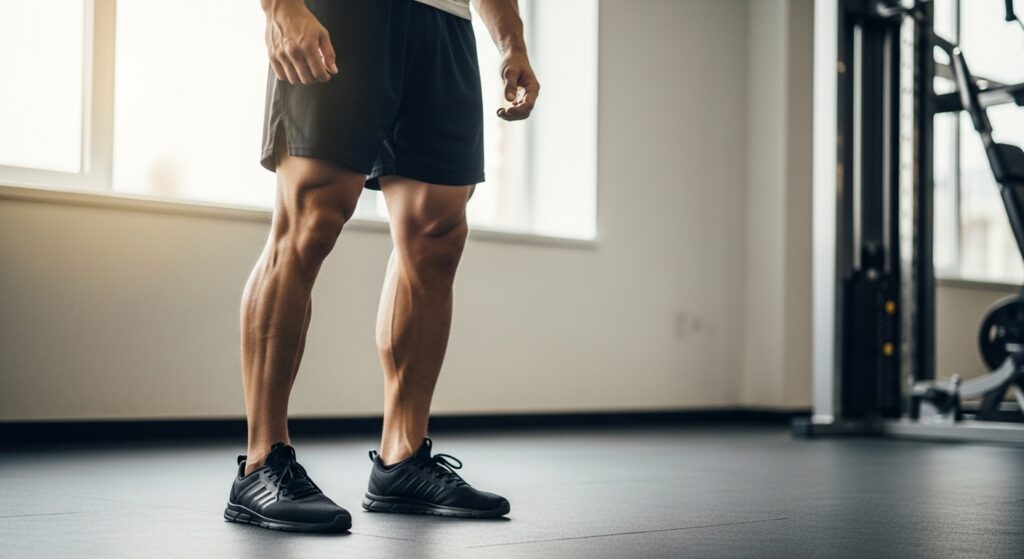
Ditch the ‘Chicken Legs’! The Importance of Calf Raises for Powerful Calves
You hit the gym hard with squats and deadlifts, building impressive quads and hamstrings. But then you catch a glimpse in the mirror and see those skinny ankles, those underdeveloped calves. No matter how much you bulk up your thighs, thin lower legs throw off your entire physique, making you look like you have the dreaded ‘chicken legs’.
Calves are often the most neglected muscle group in lower body training. However, the calves are known as the ‘second heart’, playing a crucial role in pumping blood from the lower body back to the heart, preventing stagnation. Strengthening them not only improves aesthetics but also enhances overall blood circulation, alleviates cold extremities and fatigue, and stabilizes the ankles, providing a solid foundation for squats and deadlifts.
The ultimate exercise for pushing your calves to their limit, whether at home or in the gym, is the ‘Calf Raise’. It’s a simple movement of ‘raising the calf’, but its effectiveness is dramatically altered by the accuracy of your form and a scientific approach to training.
This article will delve into the science behind calf hypertrophy, the correct form to maximize results while preventing injury, and how to revolutionize your home workouts with the latest technology.
The Science of Calf Raises: Targeting the Gastrocnemius & Soleus for Hypertrophy
To effectively build calf mass, understanding the anatomical characteristics of the target muscles is key. The calf is primarily composed of two major muscles: the ‘Gastrocnemius’ and the ‘Soleus’. By targeting these individually, you can create shapely, powerful legs.
1. The Gastrocnemius: Role and Characteristics
The Gastrocnemius is the heart-shaped muscle covering the upper part of your calf.
- Characteristics: It’s a ‘bi-articular muscle’, meaning it crosses both the knee and ankle joints, connecting the femur (thigh bone) to the heel.
- Approach: It’s most active when ‘the knee is extended’. Therefore, the ‘Standing Calf Raise’ is the most effective. It has a high proportion of fast-twitch fibers, enabling explosive power, which directly contributes to hypertrophy (muscle growth).
2. The Soleus: Role and Characteristics
The Soleus lies beneath the Gastrocnemius and extends to the outer and lower parts of the calf.
- Characteristics: It’s a ‘uni-articular muscle’, acting only on the ankle joint, connecting below the knee to the heel.
- Approach: When the knee is bent, the Gastrocnemius is relaxed, making the Soleus the primary mover. Thus, the ‘Seated Calf Raise’ is effective in this position. It has a higher proportion of slow-twitch fibers, excelling in endurance. Therefore, high-rep sets designed to induce burnout are beneficial.
Understanding the distinct characteristics of these two muscles and training them in balance is the fastest route to creating well-developed, complete calves.
Correct Calf Raise Technique for Maximum Results and Injury Prevention
Simply moving your heels up and down isn’t enough for effective calf raises. If you rely on the elastic recoil of your Achilles tendon, bouncing with each rep, the tension will shift away from the muscle, rendering your efforts futile. Strictly adhere to the following three key points to deliver an intense stimulus to your muscles with every rep.
1. Maximize Your Range of Motion (Full ROM)
While calf raises on a flat surface are beneficial, using a step (like a step platform, weight plate, or the edge of a stair) is highly recommended for maximizing muscle hypertrophy.
- Stretch (Bottom): Lower your heels well below the level of the step, feeling a deep stretch in your calves at their end range.
- Contraction (Top): Press through the balls of your feet (especially your big toe mound) to lift your heels as high as possible.
2. Control Your Contraction and Stretch
Implementing a specific tempo is crucial for completely eliminating momentum (cheating).
- Positive Phase (Concentric): Lift your heels explosively over 1 second, then squeeze hard and hold at the top for 1-2 seconds.
- Negative Phase (Eccentric): Lower your heels slowly against gravity over 2-3 seconds.
- Pause at the Bottom: To avoid using the Achilles tendon’s spring, pause for 1 second at the lowest point before initiating the next upward movement.
3. Maintain Neutral Foot Alignment to Prevent Injury
If your ankles drift outwards during the movement (similar to having collapsed arches), it places uneven stress on the Achilles tendon, increasing the risk of injury.
- Key Point: Always ensure your toes and knees point in the same direction. Keep the weight pressed through the balls of your feet (big toe mound) to drive upwards in a straight line. This ensures safe and direct loading onto the inner and outer gastrocnemius.
Pro Tip: The Importance of Nutrition and Recovery for Accelerating Hypertrophy
After a demanding workout, promptly consume protein (the building blocks of muscle) and carbohydrates (for energy replenishment). Calves are used frequently and prone to fatigue. Replenishing nutrients within the 30-minute post-workout