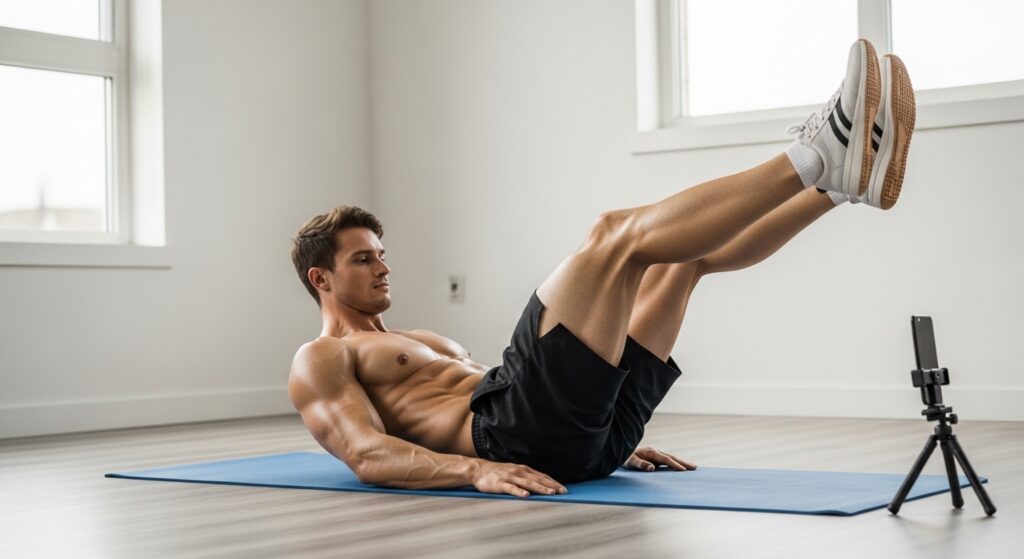
Leg Raises: The Truth About Sculpting a Six-Pack and Banishing Belly Fat
Many men dream of having a ripped six-pack and diligently perform exercises like crunches and sit-ups. However, are you struggling with stubborn lower belly fat even though your upper abs are starting to show definition? Often, standard sit-ups primarily target the upper rectus abdominis, leaving the lower part underdeveloped. This is where the highly effective leg raise comes in, powerfully engaging your lower abs using just your bodyweight.
But with its effectiveness comes a critical pitfall: the risk of lower back injury. Many people focus solely on the number of repetitions, compromising their form and engaging their lower back muscles or hip flexors instead of their lower abs. To avoid turning your hard work into an injury, a scientifically proven form and controlled movement are essential.
The Science Behind Leg Raises: How They Target Your Lower Abs
To efficiently build muscle and achieve that lean, muscular physique, understanding the mechanics of the movement is key.
Understanding Rectus Abdominis: Upper vs. Lower Function
The rectus abdominis is a single, large muscle running from your chest to your pelvis. However, due to differences in nerve innervation and muscle activation, it’s often functionally divided into an ‘upper’ and ‘lower’ section. While exercises like crunches engage the upper abs by bringing the chest towards the pelvis (trunk flexion), leg raises primarily activate the lower abs by bringing the pelvis towards the chest (pelvic tilt).
From Hip Flexion to Pelvic Tilt: The Biomechanics of Lower Abs Contraction
The leg raise movement consists of two main phases:
- Hip Flexion (Lifting the Legs): In the initial stage, the rectus femoris and iliopsoas (deep core muscles) are the primary movers.
- Pelvic Tilt (Slightly Lifting the Hips): Once the legs reach a certain height, tilting the pelvis towards your chest creates a powerful concentric contraction in the lower rectus abdominis.
Simply moving your legs up and down without proper pelvic control will overload your hip flexors, significantly reducing the effectiveness for your lower abs. Controlling your pelvis and using your lower abs as the pivot point to manage the weight of your legs is the scientific approach to maximizing muscle growth.
Preventing Lower Back Pain and Maximizing Ab Engagement: The Correct Leg Raise Form
The most crucial aspect of incorporating leg raises into your routine is preventing lower back pain. Here’s how to refine your form to protect yourself and maximize the load on your abs:
The Culprits: Pelvic Tilt and Overactive Hip Flexors
When lowering your legs while lying on your back, many people lose the battle against gravity, causing their lower back to arch off the floor (anterior pelvic tilt). This not only strains the erector spinae muscles supporting your spine but also disengages your core, forcing your hip flexors to bear the entire load. This is the primary reason for lower back pain during leg raises.
Key Form Adjustments: Maintaining Lower Back Contact and Optimal Leg Angle
To avoid injury and intensely stimulate your lower abs, adhere to these absolute rules:
- Engage in “Drawing In” to Keep Your Lower Back Pressed Down: Exhale and pull your belly button towards your spine, ensuring no gap exists between your lower back and the floor. Imagine constantly pressing your hand flat beneath your lower back.
- Control Your Leg Lift Angle: Lower your legs only to the point where your lower back remains firmly on the floor. Raising them too high can release tension from your abs. Maintaining a range of motion between approximately 30 and 75 degrees relative to the floor ensures continuous tension on your lower rectus abdominis.
- Avoid Momentum (Cheating) and Control the Pace: Lower your legs over 3 seconds and raise them over 2 seconds. Controlling the speed maximizes eccentric contraction during the lowering phase, powerfully promoting muscle hypertrophy.
Transform Your Home into a Cutting-Edge Gym with the AI Camera App “OrionFit”
Even with perfect knowledge, fatigue can lead to form breakdown during a workout, causing your leg angle to decrease or your lower back to arch. Having an objective form checker at home allows you to push past your limits safely.
This is precisely what the AI camera app “OrionFit” achieves with just your smartphone.
Real-Time Rep Counting with AI Camera for “Leg Lift Angle”
OrionFit uses your smartphone’s front camera to track your body’s movements in real-time. For leg raises, the AI determines if your legs are lifting to the target angle (range of motion) and automatically counts your reps*. This prevents the common trap of stopping reps prematurely while still counting them, ensuring each repetition is performed with consistent, high quality.
*Note: This feature uses AI camera recognition to count reps when a certain angle is reached and is intended for motion verification. It does not provide detailed form analysis or error detection.
Visualize “Rhythm” and “Consistency” with Session Scoring
Maintaining a consistent movement rhythm (avoiding cheating) is crucial for maximizing leg raise effectiveness. OrionFit provides an overall score for your workout session based on factors like leg angle stability and rep-to-rep rhythm. Focusing on improving your score naturally leads to a more controlled and effective form, turning your bodyweight training into a gamified, high-quality experience.
Furthermore, with the Pro plan, you’ll receive personalized AI-driven advice based on your accumulated workout data. Get feedback like “Your rep speed has increased in the latter half” or “Tips for stabilizing your range of motion,” much like having a dedicated personal trainer guiding you towards safe and consistent progress.
Conclusion: Achieve Your Dream Physique Safely with OrionFit as Your Partner
To eliminate stubborn lower belly fat and achieve deeply etched, sculpted abs, the scientific application of leg raises is essential. To avoid the risk of back pain and directly target your lower abs, thoroughly master the correct leg angle and consistent movement rhythm.
If you often find yourself thinking:
- “My home workouts lack proper form.”
- “I’m not confident if I’m really engaging the muscles effectively.”
Then it’s time to leverage the power of AI. OrionFit transforms your home into a state-of-the-art personal gym, turning your daily efforts into tangible results.
The right form is the fastest route to your ideal physique. Start today with OrionFit, and push your limits safely and scientifically!
Download the app now and experience the amazing AI workout: