1. Introduction: Achieve Manly Legs That Rock Shorts! Awaken Your Second Heart with Home-Based Calf Raises
A sculpted six-pack and a powerful, muscular chest are the aspirations of many men. But when you look at your lower body in the mirror, do your calves look disproportionately thin compared to your thighs, making you a ‘chicken leg’?
The common trait among lean, muscular men who effortlessly pull off a t-shirt and shorts is their well-defined, powerful calves that showcase distinct muscle cuts. No matter how intensely you train your upper body, if your foundation – your calves – are weak and slender, the overall silhouette balance is ruined. Strong ankles, the base of your lower body, are also crucial for improving performance in squats, deadlifts, and even daily activities like running and push-ups.
Don’t resign yourself to thinking that building bulky calves is impossible without specialized gym machines. The ultimate training that pushes your calves to their limit using just your bodyweight at home, enabling dramatic muscle hypertrophy, is the “Calf Raise.”
Calves are often called the “Second Heart” because they play a vital role in pumping blood from the lower body back to the heart, preventing stagnation. Training this area with calf raises not only creates manly and powerful lower legs but also offers immeasurable benefits, including improved overall blood circulation, enhanced recovery from fatigue, alleviation of cold extremities, and increased explosive power and landing stability in various sports.
Master the correct calf raise form starting today, awaken your second heart, and achieve the enviable, manly, and powerful lower body you desire!
2. The Anatomical Mechanism for Efficient Calf Hypertrophy (Gastrocnemius & Soleus)
To effectively build your calves, it’s essential to understand their anatomical structure and how to move them to apply maximum load. The main calf muscle group, the “triceps surae,” is broadly composed of two muscles:
- Gastrocnemius: Forms the upper, outer bulge of the calf (bi-articular muscle)
- Soleus: Supports the deep, lower part of the calf (uni-articular muscle)
① Gastrocnemius: Creating Volume and Manly Definition
Located on the most superficial layer of the calf, the gastrocnemius forms a beautiful heart-like silhouette when viewed from behind. This muscle is a bi-articular muscle, meaning it crosses both the knee and ankle joints. Therefore, the strongest stimulus can be applied by moving the ankle with the knee fully extended. Training the gastrocnemius intensely builds significant bulk in the upper calf and creates the sharp, defined cuts characteristic of a lean physique.
② Soleus: Building Thickness and a Solid Foundation for the Entire Calf
The soleus is a flat, powerful muscle located deep to the gastrocnemius, spreading from the lower to the outer part of the calf. As a uni-articular muscle that crosses only the ankle joint, performing calf raises with the knee bent reduces the involvement of the gastrocnemius, allowing for pinpoint targeting of the soleus. Developing the soleus adds manly thickness and density around the ankle, dramatically improving lower body stability and injury prevention.
③ The Mechanism for Maximizing Hypertrophy and Muscle Growth
Calf muscles are constantly engaged in daily movements like walking and running, making them exceptionally tough and fatigue-resistant (with a high proportion of slow-twitch fibers). This means they won’t easily grow with mediocre stimuli or simply going through the motions. To achieve significant muscle growth, the key is to apply extreme contraction and stretching across the full range of motion – fully flexing (dorsiflexion) and extending (plantarflexion) the ankle – thereby imposing strong chemical stress and mechanical tension.
3. Form is Everything! Correct Calf Raise Technique to Prevent Injury and Maximize Muscle Growth, Plus Common Mistakes to Avoid
While calf raises are a convenient bodyweight exercise, incorrect form can lead to Achilles tendon injuries or fail to adequately engage the target muscles. Let’s master the correct technique to prevent injuries and deliver an intense stimulus to your calves.
The Correct Way to Perform Calf Raises (Standing) at Home
- Start Position: Stand facing a wall or stable railing, lightly placing your hands for balance. Your feet should be shoulder-width apart, with your toes pointing straight ahead.
- Maximum Plantarflexion (Raise Heels to Limit): Exhale as you push strongly through the balls of your feet, slowly lifting your heels as high as possible.
- Peak Contraction (Hold 1-2 Seconds): At the highest point, squeeze your calf muscles intensely for 1-2 seconds. This peak contraction is crucial for muscle hypertrophy.
- Controlled Eccentric Contraction (Lower Slowly): Resist gravity and slowly lower your heels over 3 seconds. Don’t fully release tension; focus on feeling a strong stretch in your calves.
- Transition: Stop just before your heels touch the ground (or fully descend if using a step). Transition to the next rep without using momentum. Using a step or the edge of a stair can increase the range of motion and provide a powerful stretch stimulus.
3 Common Mistakes That Halve Your Training Effectiveness
- Bouncing with Momentum (Cheating): Using the elastic energy of your Achilles tendon to bounce up and down means your calf muscles do very little work. This not only wastes the load but can also lead to serious injuries like Achilles tendonitis. Always maintain a controlled, consistent speed.
- Limited Range of Motion: Performing shallow calf raises with only a few centimeters of heel lift prevents adequate muscle contraction. To push your muscles to their limit, you must raise your heels to the maximum possible angle (maximum plantarflexion angle).
- Ankles Rolling Outward (or Inward): Many people allow their ankles to roll outward (inversion) when raising their heels, shifting weight to the little toe side. This disperses the load and can injure the ankle joint. Always keep your weight on the balls of your feet and control the movement so your ankles move straight up and down vertically.
4. OrionFit’s AI Camera Instantly Analyzes Your Form! Real-Time Smartphone Training Visualizing Ankle Plantarflexion Angle and Hold Time
The biggest hurdle to maximizing calf raise effectiveness is that even when you think you’re lifting your heels to the maximum, fatigue often causes you to unconsciously reduce the angle and hold time. It’s difficult to objectively check your form during solo home workouts, making it easy to unconsciously compromise.
The cutting-edge smartphone fitness app “OrionFit” solves this problem with the latest technology, enabling you to push your limits without compromise, right in your home.
- Set up your smartphone camera ➔ AI recognizes ankle movement in real-time ➔ Maintain correct plantarflexion angle and rhythm!
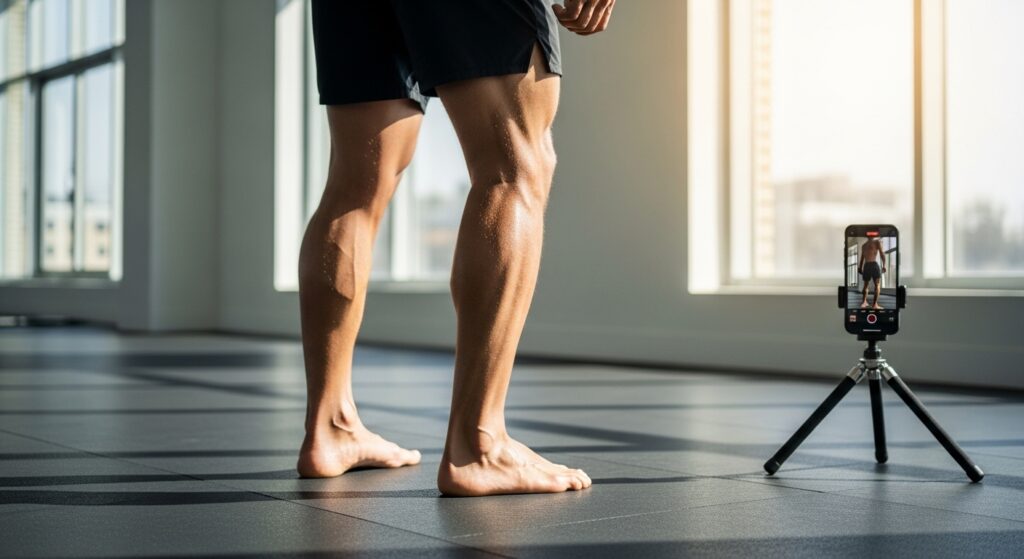
Using it is simple. Just position your smartphone camera to capture your feet and start your calf raises. OrionFit’s AI tracks and visualizes your ankle movements in real-time.
Why OrionFit Revolutionizes Home Calf Training:
- AI Rep Counting Eliminates “Cheating”: OrionFit’s AI camera only counts a rep when your ankle reaches the preset “correct range of motion (plantarflexion angle).” It doesn’t count “easy reps” performed when fatigue reduces your heel lift or range of motion. This forces you to maintain a high-quality workout focused on the full range of motion.
- Visualized Hold Time (Peak Contraction): The AI camera’s motion recognition detects and corrects bad habits like using momentum for quick movements. It ensures you hold the peak contraction at the top position, accurately capturing the moment of maximum muscle tension to help you achieve 100% muscle stimulation.
With OrionFit as your partner, you can achieve a no-compromise “futuristic smartphone workout” in your own home, as if a personal trainer were right beside you, monitoring your every move and pushing you to your limits.
5. Conclusion: Master Correct Form with Your AI Camera Partner! Achieve Your Ideal Lean Physique with OrionFit
Thick, powerful, and well-defined calves are the ultimate status symbol, proving both masculinity and high athletic ability. Even with bodyweight “calf raises” at home, you can achieve significant muscle growth by understanding the anatomical mechanisms and utilizing the full range of motion with correct form.
However, the most challenging aspect of home training is maintaining correct form consistently and pushing yourself to the limit. That’s why you should leverage the power of the latest AI technology to dramatically improve your workout quality.
With the cutting-edge fitness app “OrionFit,” which utilizes your smartphone’s camera, your home can be transformed into the ultimate personal workout studio.
3 Innovative Features of the OrionFit App:
- Precise Rep Counting with AI Camera: The AI camera instantly recognizes if your ankle reaches the designated angle during your workout to determine reps. This prevents shallow movements or “cheating” and ensures you consistently train with correct form and range of motion. (Note: This feature is for motion confirmation via camera and does not provide precise medical-grade form analysis or error detection.)
- Objective Workout Scoring: Throughout your session, the app analyzes ankle plantarflexion stability, rep rhythm, and control to provide an overall workout score. You can intuitively grasp your progress and form stability numerically.
- AI Personal Advice with Pro Plan: For those looking to take it a step further, we offer a Pro plan. Based on your accumulated workout data, AI analyzes your training tendencies and provides personalized, specific improvement advice.
Are you ready to say goodbye to skinny legs and achieve the lean, muscular lower body that makes shorts look incredible?
Install the app now from the link below and start your scientific, no-compromise calf raises with your AI partner!