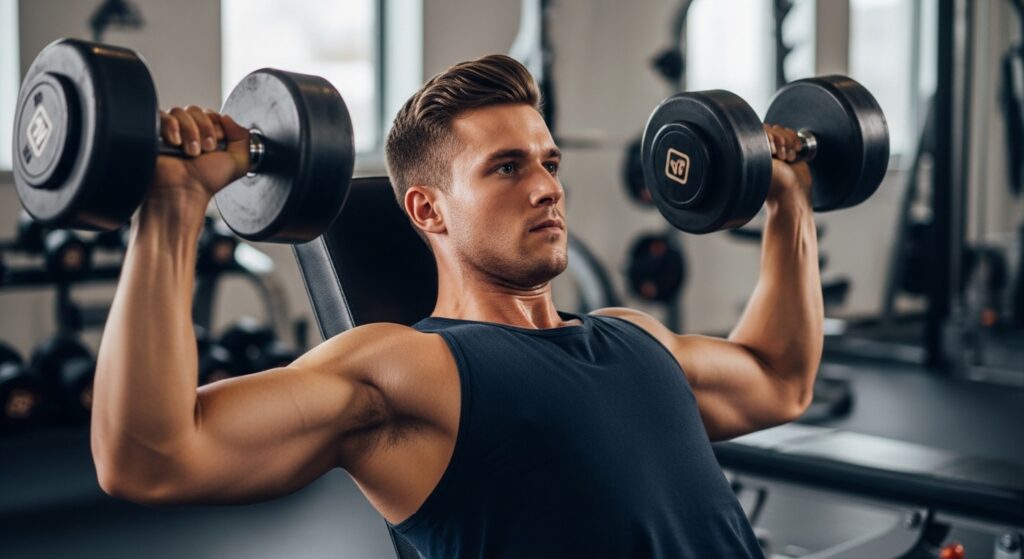
Don’t Let Your Upper Chest Lag: Scientifically Solve the “Shoulder Burn” Problem
The hallmark of a strong physique: a thick, sculpted chest that commands attention. Achieving that impressive dimension hinges on building the upper chest (clavicular head). Yet, many trainees hit a wall, struggling with common issues:
- “I’m doing incline exercises, but my front deltoids (shoulders) get all the stimulus.”
- “When I try to lift heavier, I injure my shoulder joint and have to stop training.”
The root causes lie in a lack of anatomical understanding and subtle form deviations. The upper chest fibers run at a delicate angle, and even a few degrees off can shift the load to your shoulders. This guide unlocks the secrets to the king of upper chest builders, the Incline Dumbbell Press, explaining the correct technique to pinpoint the upper chest, prevent shoulder injuries, and maximize your gains. We’ll also introduce cutting-edge smartphone AI technology to dramatically enhance your training precision.
Why the Incline Dumbbell Press? The Decisive Edge Over Barbell Presses
While the incline barbell press is popular for upper chest development, the dumbbell version offers superior benefits for muscle hypertrophy and injury prevention.
① Unrestricted Path for Maximum Contraction and Injury Prevention
Barbells, fixed by a single bar, force a linear path, often locking the shoulder joint at unnatural angles and straining the rotator cuff. Dumbbells, however, move independently, allowing a natural, individual path of motion. This enables a deep stretch at the bottom and a powerful squeeze at the top by adducting the dumbbells, fully engaging the upper chest’s key function and maximizing muscle contraction.
② Pinpoint Upper Chest Stimulation
Upper chest fibers run diagonally from the clavicle towards the humerus. Dumbbells allow you to align the resistance precisely with the muscle fiber direction. This eliminates wasted tension and delivers potent mechanical tension directly to the upper chest, the primary advantage of dumbbell presses.
The Science of Maximum Upper Chest Contraction: Correct Form and Setup
Mastering the setup is crucial for hitting the upper chest 100% with the incline dumbbell press. Focus on these three key points:
① The Golden Rule: Bench Angle at 30-40 Degrees
Too steep an angle shifts the load from the chest to the anterior deltoids. Scientific studies show that the ideal bench angle for peak upper chest activation is between 30 and 40 degrees. Angles above 45 degrees will shift the target to your shoulders. Adjust the bench precisely to find your sweet spot.
② Scapular Retraction and Depression, Maintain the Bridge
Before lifting the dumbbells, always retract and depress your scapulae (pull shoulder blades back and down). Keeping your shoulder blades firmly pinned and maintaining a slight arch in your upper back prevents your shoulders from rolling forward during the press. Forward shoulder movement not only reduces chest activation but also severely risks shoulder injury. Drive through your feet to transfer power from your lower body to your chest.
③ Maintain Forearm Verticality
Throughout the entire movement, your forearms must remain perpendicular to the floor. If your elbows flare out too much at the bottom or tuck in too tightly, the stress shifts to your elbow and wrist joints. Keeping your forearms vertical and your elbows directly under the dumbbells ensures the force of gravity is channeled straight into your upper chest.
Prevent Injuries with the OrionFit App’s AI Camera: Smart Measurement of Dumbbell Path and Elbow Angle for Ultimate Training
Even with perfect knowledge, objectively checking your forearm’s position or range of motion while handling heavy dumbbells is incredibly difficult. Near failure, form inevitably breaks down, dramatically increasing injury risk.
Transform your smartphone into the ultimate personal trainer with the cutting-edge fitness app, OrionFit.
AI Camera for Smart Rep Counting
Simply place your phone near the bench, launch OrionFit, and revolutionize your training. The AI camera detects when you reach the target range and counts your reps. This helps you avoid shallow presses near failure and ensures you’re consistently working through a full range of motion. (Note: This feature is for motion confirmation, not precise form analysis. However, objective feedback significantly boosts form awareness.)
Visualize Your Progress with Workout Scoring
The speed and consistency of your dumbbell lifts directly impact the quality of muscle stimulus. OrionFit scores your entire workout session based on factors like angle stability and rep rhythm. Seeing how your performance compares to previous sessions allows you to pursue the true essence of hypertrophy: applying high-quality tension, not just chasing weight.
Break Through Plateaus with Pro Plan AI Coaching
For those aiming for the next level, OrionFit’s Pro plan offers personalized AI-driven advice based on your accumulated workout data. Receive feedback like, “Your angle tends to falter in later sets” or “Focus on increasing time under tension by controlling the tempo.” This data-driven guidance helps overcome training plateaus and carve out an impressive chest efficiently.
Conclusion: Forge Your Ideal Chest – Thick and Powerful
To build a commanding, sculpted chest, mastering the science-backed Incline Dumbbell Press is essential:
- Set the optimal bench angle between 30-40 degrees.
- Retract and depress your shoulder blades to eliminate shoulder strain.
- Maintain forearm verticality to prevent injury and focus load on the upper chest.
Maximize your efficiency by leveraging technology. Download the app now and elevate your chest training to the next level for smarter, safer, and more powerful gains!