For Those Who Injured Their Backs on Deadlifts! Safely Maximize Back ‘Thickness’ with Rack Pulls
The unshakeable rule in the fitness world is: ‘To build a bigger back, do deadlifts.’ However, simultaneously, many trainees have the bitter experience of ‘injuring their lower back doing deadlifts and having to halt their training.’
While floor-pull deadlifts, where you lift the barbell from the floor, are indeed an excellent full-body exercise, they carry an extremely high risk of serious injury if the form falters even slightly. This is because the upper body leans forward significantly, placing immense stress on the lumbar spine (lower back bones).
‘I want to achieve a thick, powerful ‘demon back’ while thoroughly minimizing the risk of injury.’
The exercise that perfectly fulfills this earnest desire of trainees is the ‘Rack Pull (Half Deadlift)’, which I will introduce today.
Rack pulls utilize the safety bars of a power rack, allowing you to pull the barbell from just below knee height. By cutting out the ‘most stressful and form-breaking bottom position (from floor to knee)’ of the floor-pull deadlift, you can dramatically eliminate danger to your lower back while subjecting your back muscles to significantly heavier weights than a full deadlift.
The days of holding back on back training due to fear of injury are over. Let’s understand the scientific mechanics of rack pulls and master the technique to safely destroy (bulk up) your back to the extreme.
Why Rack Pulls? The Decisive Difference from Floor-Pull Deadlifts and How They Target Muscles
The reason rack pulls are considered supreme for ‘building back thickness’ lies in their unique range of motion and their pinpointed load mechanism on target muscles.
The Decisive Difference from Floor-Pull Deadlifts
In floor-pull deadlifts, you use your lower body (hamstrings and glutes) to lift the barbell off the floor. At this point, the upper body leans forward the most, applying a strong ‘shear force’ on the lumbar spine that feels like it could tear it apart.
In contrast, rack pulls start from around knee height, so the forward lean of the upper body is shallower, minimizing physical stress on the lower back. Furthermore, since they are performed in a half range of motion where the human body can exert its greatest muscular strength, their biggest advantage is applying ‘overload’ that far exceeds your body weight or normal max weight, directly to your upper back.
Load Mechanism on Target Muscles
Rack pulls target and build a thick, three-dimensional back by focusing on the following three areas:
- Trapezius (Mid/Lower): During the ‘lockout’ phase at the top of the pull, powerfully squeezing your shoulder blades inward (adduction) places intense stress on the central back. This creates the ‘back bulge’ that stands out even through a t-shirt.
- Latissimus Dorsi (Upper)/Teres Major: In the process of pulling the heavy barbell towards your body without letting it drift away, strong isometric (static) contraction is sustained in the upper lats, which contribute to back width.
- Erector Spinae: To support the extremely heavy barbell and maintain an upright posture, the erector spinae muscles along the spine work to their fullest. This creates the ‘deep groove’ running down the center of your back.
Protect Your Back and Push Your Muscles to the Limit! Correct Form, Hip Hinge, and Scapular Squeeze Techniques
Even though rack pulls are safe, performing them with sloppy form can still injure your lower back. Strictly adhere to these three golden rules to place 100% of the load on your back and protect it.
① Correctly Setting the Safety Bar (Starting Position)
The height of the safety bar where you place the barbell should be set ‘just below the knees’ or ‘just above the knees’.
- Below the Knee Start: Recommended for increasing the load on the lats and erector spinae. The wider range of motion requires more focus on the lower back.
- Above the Knee Start: Recommended for handling overwhelmingly heavy weights and targeting extreme thickness in the traps (upper back).
Start with ‘just below the knees’ and focus on getting a solid feel for the load on your back.
② The ‘Hip Hinge’ and Maintaining a Neutral Spine
The most common errors in rack pulls are ‘trying to lift the bar using only hand and arm strength’ and ‘bending the knees too much, turning it into a squat’.
The key to the correct movement is the ‘hip hinge’.
After gripping the bar, fold at your hip joints by pushing your glutes backward, keeping your spine straight (neutral). By puffing out your chest and slightly tucking your chin, you prevent your back from rounding. Ideally, your entire back should feel tension even in this starting position.
③ Scapular Squeeze at the Top and Finish
When pulling the barbell up, imagine firmly pressing the soles of your feet into the floor and pushing your hips forward (lockout).
At the moment you reach the top position, fully contract your back muscles by ‘puffing out your chest and squeezing your shoulder blades tightly towards the center of your back’. At this time, absolutely avoid hyperextending your lower back. Complete the movement safely by keeping your pelvis neutral and squeezing your glutes (gluteus maximus).
Conquer Your Limits Smartly with OrionFit’s AI Camera! Revolutionize Your Back Training with Correct Range of Motion Judgment and AI Analysis
The sole weakness of rack pulls is that ‘as the weight gets heavier, even if you think you’re pulling straight, your back tends to round (cat-back phenomenon)’. In the final reps of a maximum effort set, when your brain is starved of oxygen, it’s impossible to objectively check your form.
The next-generation fitness app, ‘OrionFit’, solves this problem and dramatically smartens up your gym training.
Your Smartphone’s AI Camera Becomes Your Dedicated Supporter
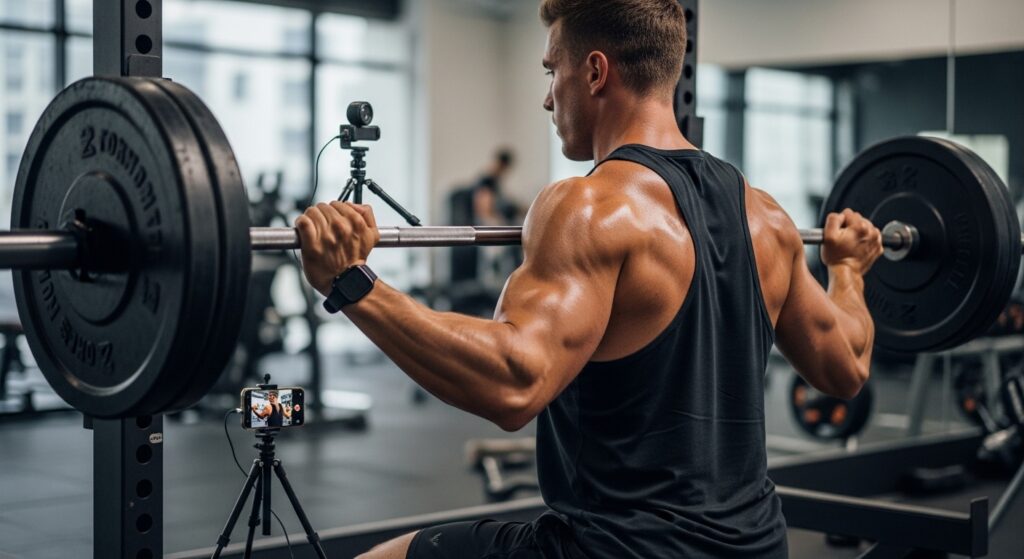
Simply set up your smartphone during training and activate the app’s AI camera to digitally upgrade your workout.
- Real-time Range of Motion and Rep Counting
OrionFit’s AI camera recognizes joint movements and determines if your body has reached the required angle (correct range of motion) during training, accurately counting reps (※This is a function for motion confirmation by camera, not for precise form analysis or error detection). It strictly excludes reps that don’t meet the ‘half-range’ due to insufficient pull, allowing you to record only high-quality sets. - Workout Scoring Function
Throughout the session, the AI analyzes the stability of your pulling angle and the lifting rhythm of each rep. You get an objective score for ‘today’s rack pull completion quality’. Weaknesses, such as ‘movements becoming unstable due to fatigue in the latter half,’ are immediately visible as numerical data. - Pro Plan Advice to Support Pushing Your Limits
Furthermore, with the Pro plan, the AI provides personalized advice based on your accumulated workout data. It feeds back, much like a personal trainer, on when your form tends to break down and what to focus on in your next session.
Precisely because rack pulls involve extremely heavy weights, pairing them with AI’s ‘accurate data’ rather than human ‘subjectivity’ minimizes the risk of injury and maximizes the speed of muscle hypertrophy.
Achieve Your ‘Demon Back’ with Safe Heavy Weight Training with OrionFit as Your Partner!
The ‘thickness’ that brings overwhelming presence to a man’s back. The ‘Rack Pull (Half Deadlift)’ is the safest and most efficient exercise to build it with the heaviest weights.
If you’ve been compromising your training due to lower back pain from floor-pull deadlifts, rack pulls allow you to safely break through your limits. Focus on the correct hip hinge and intense scapular squeeze to bulk up your entire back to the extreme.
And the smartest, most scientific support for this challenge to your limits is the OrionFit app.
By utilizing the reliable rep counting via AI camera, workout scoring, and personalized advice from the Pro plan, every rep in the gym will transform into ‘your best rep’. Armed with objective data, why not achieve the ‘demon back’ that everyone admires, faster than anyone else?
Install the app now and elevate your back training to the next level!