1. Why is the Deadlift Called the ‘King of Exercises’? Its Overwhelming Effects and Hidden Risks
For anyone serious about bodybuilding and bulking up, the deadlift, one of the ‘BIG3’ exercises, is essential. Among all training exercises, the deadlift is hailed as the ‘King of Exercises’. This is because its simple motion of lifting a barbell off the floor encapsulates the mechanism for awakening explosive power throughout the entire body.
The primary reason the deadlift earns its kingly title is the sheer amount of muscle mass mobilized at once. It engages almost all the muscles on the posterior chain – the back, glutes, hamstrings, and core. This ultra-high intensity stimulus strongly promotes the secretion of testosterone and growth hormones, which drive muscle growth, making it the ultimate trigger for the fastest overall physique expansion. It is truly a god-tier exercise that men seeking to build a big physique efficiently cannot afford to skip.
However, behind its immense effectiveness lies a significant risk of injury. The deadlift is one of the exercises most notorious for causing lower back pain. Lifting with a ‘rounded back’ places hundreds of kilograms of shear force on the lumbar spine, potentially causing severe injuries like a herniated disc in an instant.
To achieve maximum muscle hypertrophy with the deadlift, mastering the correct form and ensuring safety are absolute prerequisites.
—
2. The Deadlift’s Extreme Bulking Effects and Major Muscle Groups Targeted
The deadlift is more than just a ‘back exercise’. By coordinating the entire body’s muscles, you can simultaneously build a thick back and powerful lower body. Here’s a logical explanation of the major muscle groups trained by the deadlift and the mechanism behind its bulking effects.
Entire Back (Lats, Traps, Erector Spinae)
During the lift, the erector spinae work isometrically to prevent the back from rounding. As you pull the barbell towards your body, the lats and traps are intensely engaged. This builds a masculine, thick, and wide ‘demon back’.
Glutes and Hamstrings
The prime movers in the deadlift are the gluteal muscles (glutes) and the posterior thigh muscles (hamstrings). By powerfully extending the hip joint, these muscles experience intense eccentric (lengthening) load. Training these powerhouses of the lower body drastically boosts basal metabolism, evolving your body into a lean, agile physique that’s resistant to fat gain.
Core (Rectus Abdominis, Obliques, Intra-abdominal Pressure)
To support heavy weights, the abdominal muscles contract rigidly like a corset. This strengthens the inner muscles, leading to a solid core that directly contributes to increasing your maximum lifts (MAX) in other exercises like squats and bench presses.
—
3. Prevent Lower Back Pain: Mastering the Correct Deadlift Form and the Crucial ‘Hip Hinge’
To perform the deadlift safely and apply 100% of the load to the target muscles, mastering the ‘hip hinge’ (folding at the hips) is essential. Many trainees suffering from lower back pain fail to execute the hip hinge correctly, lifting the bar by bending their lower back.
What is the ‘Hip Hinge’?
A hip hinge is the ‘motion of pulling your hips back while keeping your knees nearly fixed’. Imagine pushing open a door with your glutes; the movement involves tilting your pelvis forward to lean your upper body down, maintaining a straight spine. The key is to keep the lumbar spine in a neutral, straight position, absorbing the load entirely with your glutes and hamstrings.
Correct Deadlift Form (From Setup to Lift)
- Stance Width and Bar Position
Stand with your feet about hip-width apart, positioning the barbell over the middle of your shoelaces (above the arch of your foot). The distance between the bar and your shins should be about two fingers’ width (a few centimeters). - Hinge at the Hips to Squat Down
Bend at the hips, push your glutes back, and lower your hands to grip the bar slightly wider than shoulder-width. Be careful not to let your knees travel too far forward. - Chest Up, Brace Your Back
Slightly depress your shoulder blades (pull them down) and straighten your back with your chest puffed out. Inhale deeply, filling your belly with air, and create maximum intra-abdominal pressure to stabilize your core (Valsalva maneuver). - The ‘Ground Press’
When initiating the lift, do not pull the bar up with your hands. Think of ‘driving your feet powerfully into the floor’, using the strength of your hips and glutes to stand up explosively. - Finish and Descent
At the top, pull your shoulders back into a straight standing position and hold for one second (avoid excessive back arching). For the descent, maintain the hip hinge; keep your hips moving back until the bar passes your knees, then bend your knees to lower the bar to the floor.
—
4. Leverage OrionFit App’s AI Camera for Injury-Free Max Lifts: Eliminating Lower Back Rounding
“I understand the form in my head, but my lower back rounds when I lift heavy weights…”
The cutting-edge smartphone fitness app, OrionFit, offers a smart solution to this common trainee problem.
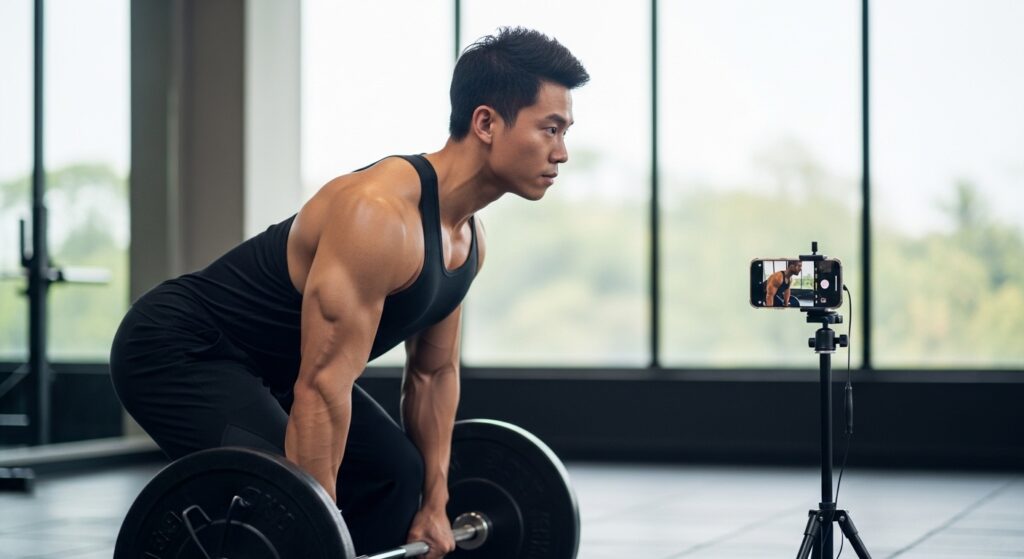
Simply relying on gym mirrors makes it difficult to objectively assess your pelvic tilt or back curvature in real-time during a deadlift. By activating OrionFit’s AI Camera feature and setting up your smartphone camera horizontally beside you while you perform the exercise, your deadlifts will evolve into a dramatically safer and more scientific approach.
Accurate Movement Verification and Motivation Boost with AI Camera
OrionFit’s AI camera tracks your body’s movements during workouts in real-time. It accurately counts reps by recognizing when specific joint angles are achieved, preventing shallow reps and ensuring you consistently perform high-quality repetitions. (※ While this feature is not designed for precise form analysis or error detection, it serves as an unparalleled powerful aid for objective movement verification.)
Workout Scoring and Pro Plan AI Personalized Advice
OrionFit is more than just a workout logger.
- Session Scoring: The AI analyzes and scores the stability of your joint angles and the rhythm of your reps (consistency in lifting speed) throughout your workout. This allows you to numerically track whether your form was more stable than last time, making form improvement a gamified experience.
- Pro Plan Personalized AI Advice: Furthermore, upgrading to the Pro Plan (paid) provides AI-driven personalized feedback and advice based on your accumulated workout data. It logically guides you on ‘which weight to aim for in the next session’ or ‘which muscles to strengthen to maintain form’, creating an environment as if you have a dedicated personal trainer by your side.
—
5. Conclusion: Forge a ‘Demon Back’ with a Scientific Approach. Reach Your Strongest Physique with OrionFit
When performed correctly, the deadlift is the ‘fastest route’ to guaranteed full-body gains, but it’s a double-edged sword that can lead to serious injury if done improperly. Breaking free from sensation-based training and adopting a scientific approach focusing on ‘mastering the hip hinge’ and ‘objective form verification’ is the only way to prevent injuries and continuously break your personal bests.
To achieve sufficient training effects, consistent practice with correct form, adequate protein intake (protein shakes and mass-gainer foods), and proper rest are essential. As a foundation for managing this cycle, start with ‘measuring and recording your correct form’.
Harness the power of the latest technology and pursue your bulking journey smartly and passionately. Make OrionFit your ultimate partner in achieving the impressive physique everyone admires.
Start your smarter, stronger workout life today, pushing beyond your limits!