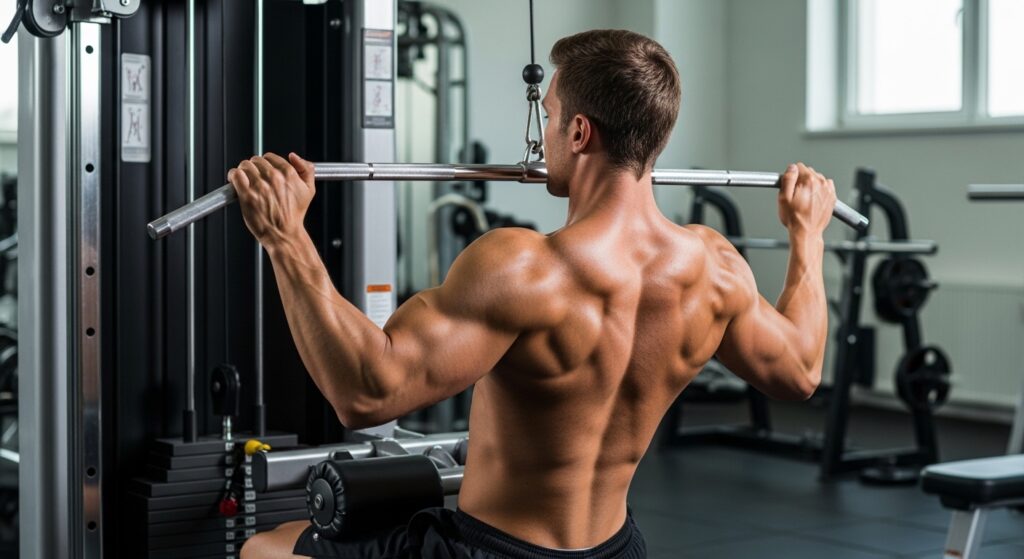
Forge Your Ultimate ‘V-Taper’ Physique: Why Your Lat Pulldowns Aren’t Hitting Your Back?
The widely admired physique of a broad, powerful back. The iconic ‘V-taper’ body line, evident even through a t-shirt, symbolizes masculinity and commanding presence. The most effective exercise for achieving this ideal back shape fastest in the gym is the ever-present ‘Lat Pulldown’.
However, many gym-goers hit a significant roadblock with lat pulldowns. “My arms get fatigued instead of my back.” “The soreness the next day is only in my arms or the back of my shoulders, not my lats.” These are classic struggles for beginners and intermediate trainees.
While seemingly a simple ‘pulling a bar down’ motion, the lat pulldown is surprisingly complex and prone to form errors. Neglecting the root causes of ineffective lat pulldowns and only increasing the weight will not stimulate your target lats at all, turning it into an arm-thickening exercise.
This article will anatomically dissect why your lat pulldowns fail to engage your back and thoroughly explain the correct form and scientific approach to maximize hypertrophy of the teres major and latissimus dorsi.
Why Isn’t Your Back Getting Wider? 3 Critical Form Mistakes Killing Your Lat Activation
The biggest reason your back isn’t widening is the unconscious execution of ‘incorrect form (error form)’. The following three mistakes are particularly critical errors that completely let the load escape your lats.
① The ‘Hand Pull’ (Using Only Arm Strength)
The most common error is gripping the bar too tightly with your ‘hands and arms’ and pulling it down using your biceps. The human brain prioritizes arm muscle activation when grip strength increases (due to the synergy between grip and arm muscles). This leads to your arms (biceps and forearms) reaching their limit before your target lats can even engage.
② Overly Leaning Back (Excessive Torso Tilt)
Trying to lift too much weight often results in leaning the upper body back by over 45 degrees and using body momentum to pull. Leaning back excessively shifts the load’s direction from ‘top-to-bottom’ to ‘front-diagonal-to-back’. This essentially turns the lat pulldown into a ‘Seated Row’ exercise. This form targets the thickness of the back (mid/lower traps) rather than the width of the lats (teres major).
③ Shrugging Shoulders (Elevated Scapula)
This involves shrugging your shoulders towards your ears as you pull the bar down. To maximize lat contraction, the downward movement and retraction of the scapula (shoulder blades) are essential. However, shrugging immobilizes the scapula, concentrating the load on the shoulder’s rotator cuff muscles and upper traps. This not only fails to hit the lats but also increases the risk of neck and shoulder injuries.
—
Induce Extreme Hypertrophy! The Correct Form and ‘Full Contraction’ Mechanism
To deliver an intense stimulus to your back and forge that V-taper fastest, you need to master anatomically sound movements.
Target Muscles: Precision Strike on Lats and Teres Major
The primary muscles to target with lat pulldowns are the ‘Latissimus Dorsi (Lats)’ and the ‘Teres Major’.
- Teres Major: Located under the armpit, developing this muscle creates width in your back, emphasizing the V-taper from the front.
- Lats: A large muscle spanning the mid to lower back. Building mass here creates overall back thickness and dimension.
Pelvic Tilt and Grip Technique
- Sit with an Erect Pelvis: When sitting on the bench, avoid tilting your pelvis backward. Keep it erect and maintain a straight spine. Lightly puff out your chest and slightly extend your thoracic spine (the mid-back area) towards the cable’s direction.
- Adopt a Thumbless Grip: Do not wrap your thumb around the bar. Use a ‘thumbless grip’ where your thumb is alongside your index finger. Furthermore, instead of gripping with your fingertips, hook the bar with the pinky-side of your palm (hypothenar eminence). This minimizes arm involvement and prioritizes neural drive to the back.
The Secret to Full Contraction: Mastering the ‘Pull-Through’
The essence of the lat pulldown lies in achieving maximum contraction at the bottom position (full contraction).
- Focus on ‘Elbows’: Don’t pull with your hands; instead, imagine ‘inserting your elbows into your back pockets’ as you pull down.
- Pulling Position: Pull the bar towards the area slightly below your collarbones (upper chest). Maintain a slight torso lean of approximately 15-20 degrees within the optimal range.
- Scapular Depression and Retraction: As the bar approaches your chest, squeeze your shoulder blades together towards your spine (retraction) while simultaneously pulling them forcefully downwards (depression). At this ‘full contraction’ moment, your lats and teres major will intensely contract, providing the stimulus for maximum hypertrophy.
—
Smarten Up Your Back Training with OrionFit’s AI Camera: Visualizing Torso Lean and Pulling Trajectory
While you understand the importance of correct form, it’s incredibly difficult to objectively assess