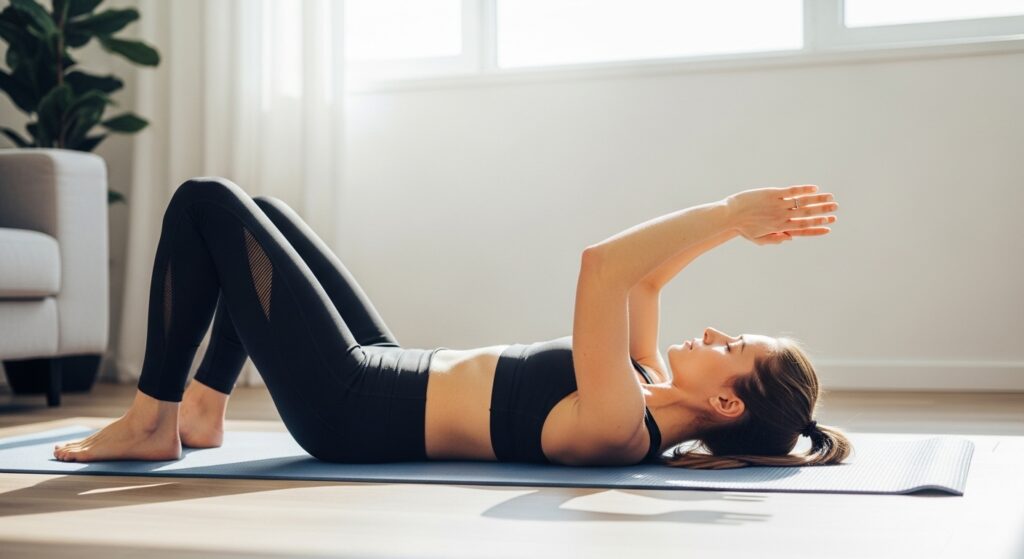
Tired of Belly Bloat and Lower Back Pain? Discover the Ultimate Home Core Workout: The Dead Bug!
Want to flatten your belly and improve your posture, but find that traditional ab exercises cause back pain? Many common ab exercises, like crunches, can strain your neck and back if your core muscles aren’t strong enough. That’s why we highly recommend the Dead Bug exercise – a high-performance, safe, and effective core workout you can do right at home, even if you’re a beginner!
Despite its unusual name, the Dead Bug exercise is incredibly effective and used by everyone from athletes to physical therapists. It’s low-risk for beginners and excellent for toning your midsection. This article will dive into the benefits of the Dead Bug, guide you through the correct form, and introduce a modern way to perfect your technique with AI technology.
Why is the Dead Bug So Effective? Benefits for Inner Core Strength and Posture
The Dead Bug primarily targets your deep core muscles, including the transverse abdominis and multifidus, as well as your pelvic floor. Strengthening these muscles, which act like an internal corset, offers several fantastic benefits:
- Flatten Your Belly: Activating your inner core muscles helps lift internal organs back to their proper position, reducing the appearance of a protruding lower belly.
- Improve Posture & Fix Lower Back Arch: This exercise strengthens your core to stabilize your pelvis, correcting imbalances like swayback (excessive lower back arch) and improving overall posture. You’ll stand and sit taller naturally.
- Reduce Lower Back Strain: By building internal support, the Dead Bug significantly reduces stress on your lower back during daily activities and other exercises like squats and lunges. It’s ideal for strengthening your core safely.
How to Perform the Dead Bug Correctly: Form and Breathing
To maximize the benefits, mastering the correct form is crucial. Focus on the movement of your limbs and your breathing rhythm.
Basic Form and Limb Movement:
- Lie Down, Lift Limbs: Lie on your back with your arms extended straight up towards the ceiling and your knees bent at a 90-degree angle, shins parallel to the floor (tabletop position).
- Engage Core, Lower Back Flat: Gently draw your belly button towards the floor, pressing your lower back firmly against the mat. This is the most critical step: keeping your lower back down.
- Lower Opposite Arm and Leg: Slowly exhale as you extend your right arm back towards the floor behind your head and your left leg forward, lowering them simultaneously towards the floor without touching it.
- Return and Repeat: Inhale as you slowly return to the starting position. Then, repeat the movement with your left arm and right leg. Continue alternating sides.
Breathing Technique:
- Exhale slowly and steadily as you extend your arm and leg.
- Inhale as you return to the starting position.
Maintaining a steady breathing rhythm enhances the stimulation of your transverse abdominis. Aim for 10-15 repetitions per side, for 3 sets.
Common Dead Bug Mistakes to Avoid
The Dead Bug may look simple, but neglecting key points can reduce its effectiveness and increase injury risk. Watch out for these common errors:
Mistake 1: Lowering Your Back Off the Floor
Your lower back arches, creating a gap between your back and the floor when extending your limbs.
- Cause: Weak core stabilization or extending limbs too far/fast.
- Solution: Only lower your limbs to the point where you can maintain a flat lower back. Shortening the range of motion (e.g., bringing your legs up higher) can help.
Mistake 2: Unmoving Limbs Move Unintentionally
The arm and leg that should be held stable start to shake or move while the opposite limbs are extending.
- Cause: Lack of core control and coordination.
- Solution: Consciously focus on keeping the non-moving limbs completely still. Slow down the movement and ensure you have control throughout the entire range.
Important: If you feel sharp pain in your back or joints, stop the exercise immediately and consult a healthcare professional.
Introducing OrionFit: AI Camera for Real-Time Angle and Rhythm Tracking
Home workouts can leave you wondering,