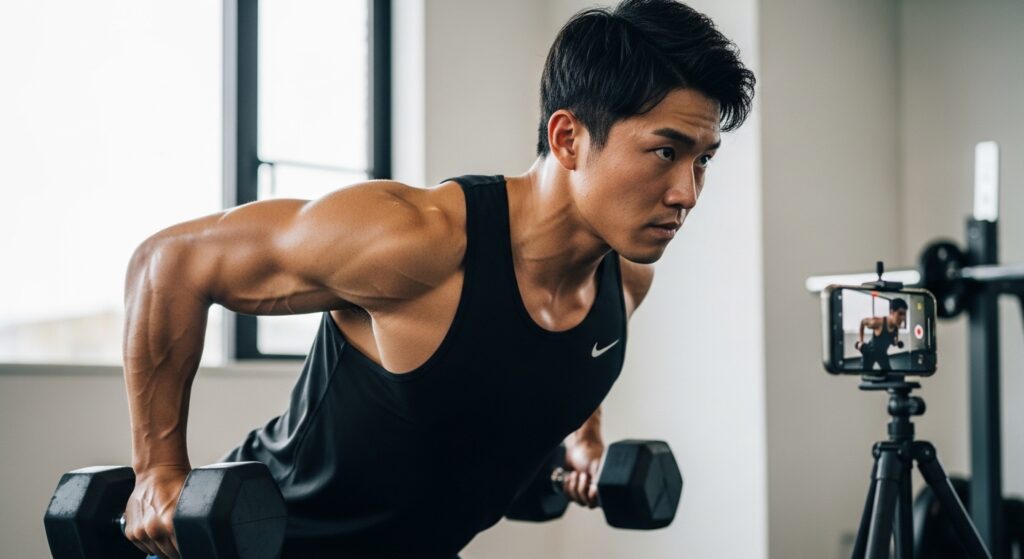
1. Why Rear Delt Raises Are Essential for Men’s Muscle Gain: A Scientific Approach to Building a V-Taper Physique
When aiming for a masculine, well-defined V-taper physique, many trainees focus excessively on back width (lats) or shoulder width (lateral deltoids). However, the crucial element for creating truly impressive, rounded, and three-dimensional “melon shoulders” is the posterior deltoid, or “rear delt.” This often-neglected muscle group is the final piece of the puzzle.
The “Posterior Deltoid”: The Key to 3D Shoulders (Melon Shoulders)
The deltoid muscle is divided into three parts: anterior (front), lateral (side), and posterior (rear). Each plays a different role. Pressing movements like bench presses and overhead presses primarily work the anterior deltoid, while side raises target the lateral deltoid. In contrast, the posterior deltoid is only strongly activated by movements that involve pulling the arm backward or backward and outward (horizontal abduction and extension of the shoulder joint).
This means that without intentionally incorporating exercises that specifically target the rear delts, your shoulders will remain flat, only looking good from the front. Strengthening your posterior deltoids dramatically enhances the definition between your shoulder and arm, adds impressive thickness when viewed from the side, and contributes to a more powerful-looking back from behind.
A Scientific Approach: Applying “Mechanical Tension” with Low Weight and High Precision
Anatomically, the posterior deltoid is a pennate muscle, meaning it has the potential to generate significant force. However, it’s less frequently used in daily movements, leading to weaker neural drive and making mind-muscle connection extremely challenging during training. Furthermore, nearby large back muscles like the traps, lats, and teres major can easily take over the movement if you use excessively heavy weights, causing the tension to shift away from the target muscle. Therefore, for rear delt raises, the most effective approach for hypertrophy is not to “swing heavy weights,” but rather to apply “mechanical tension” through a precise range of motion with lighter weights, maintaining constant tension on the target muscle (metabolic stress via high reps).
2. Hit the Target Precisely! Correct Form and Cheating Countermeasures for Posterior Deltoid Activation
To effectively work your posterior deltoids to failure with rear delt raises, you must master a strict, precise form that rigorously prevents your back muscles from assisting. Here’s how to perform the bent-over rear delt raise, a home-friendly exercise:
Correct Basic Posture and Movement Process
- Establishing the Start Position (Hip Hinge)
- Stand with feet hip-width apart, holding dumbbells in each hand.
- Hinge at your hips, bending your torso forward until it’s at a 45-degree angle to the floor, or as close to horizontal as possible.
- Keep your knees slightly bent to act as shock absorbers, and maintain a stable base with your weight distributed across the soles of your feet (slightly forward on the balls of your feet).
- Let the dumbbells hang directly below your shoulders, palms facing each other.
- Controlled Elevation (Positive Movement)
- Instead of “lifting the dumbbells with your hands,” think of “pushing your elbows out and away” as you open your arms out to the sides (or slightly backward).
- Keep your elbows slightly bent (about 10-20 degrees) to avoid stressing the joint.
- Focus on initiating the movement with your pinkies to reduce forearm involvement and enhance the contraction in your posterior deltoids.
- Squeeze at the Top (Peak Contraction)
- Pause momentarily when your arms reach about parallel to the floor, squeezing your rear deltoids and feeling the contraction.
- Controlled Lowering (Negative Movement)
- Slowly lower the dumbbells over 2-3 seconds, resisting gravity. Reverse the motion just before the dumbbells touch, maintaining constant tension on the muscles.
Common Cheating Errors and How to Avoid Them
- Error ①: Torso Rising During the Movement
- As you fatigue, you might unconsciously start to straighten your torso. This shifts the angle of resistance, taking tension off the rear delts and placing it onto the lateral deltoids or upper traps. Maintaining a constant forward-leaning angle is the most crucial rule for rear delt raises.
- Error ②: Squeezing Shoulder Blades Together (Back Compensation)
- The most common mistake is retracting your shoulder blades as you lift the dumbbells. This engages your back muscles (middle/lower traps, rhomboids). To counter this, keep your shoulder blades retracted (spread apart) and focus on moving your arms solely through shoulder joint movement.
- Error ③: Using Body Momentum (Cheating) to Swing the Dumbbells
- Bouncing your knees or hips to lift the weight eliminates tension on the target muscles. If you can’t perform the rep without momentum, the weight is too heavy. Immediately reduce the weight and choose a lighter load that allows for controlled, proper form.
3. Maximize Your Form with OrionFit’s AI Camera: Real-time Measurement of Incline Angle and Arm Movement
Understanding the importance of rear delt raises and their proper form is one thing, but applying it correctly alone at home or the gym presents a significant challenge. It’s incredibly difficult to objectively assess whether you’re maintaining the correct torso angle or if your arms are drifting off course due to fatigue. Simply looking in a mirror can alter your spinal alignment and increase injury risk.
Enter OrionFit, a revolutionary workout support app that uses your smartphone’s AI camera to dramatically enhance your home training experience.
Accurate Movement Analysis and Rep Counting with AI Camera
Simply set up your smartphone so the camera captures your silhouette from the side, and OrionFit transforms your space into a high-tech personal training studio.
- Real-time Tracking of Torso Angle and Arm Elevation
The AI camera accurately recognizes your skeletal structure and joint positions, visualizing your torso’s forward lean angle and arm elevation angle on screen – key metrics often compromised during rear delt raises. - Uncompromisingly Accurate Rep Counting
The AI camera automatically counts reps only when your body reaches the pre-set correct range of motion. This strictly eliminates “shallow reps” achieved through momentum or “wasted reps” performed with a compromised torso angle. You’ll be able to accumulate only “quality reps” that effectively target the posterior deltoids.
*(Note: This feature is for movement verification and does not perform detailed form analysis or error detection.)*
Scoring System to Boost Your Motivation
OrionFit is more than just a rep counter. It analyzes the “stability of your torso angle” and the “rhythm of your lifting speed” during your workout and scores your performance using a unique algorithm. Seeing quantifiable results of whether you maintained form until the end, including controlled negatives, makes improving your form feel like conquering a game. Competing against your previous high scores will ignite your motivation for home workouts.
Pro Plan: Personalized Advice from Your Dedicated AI Trainer
For intermediate to advanced trainees aiming for the next level of muscle gain, OrionFit offers a “Pro Plan.” This plan leverages advanced analysis of your daily training data to provide personalized, actionable feedback from the AI. Receive logical and scientific advice, such as, “Your torso angle tends to decrease by 5 degrees towards the end of the set. Consider lowering the weight by 1kg and focusing on strictness for the last 3 reps.” This guidance helps you progress efficiently while minimizing injury risk on your path to achieving melon shoulders.
Conclusion: Break Through Your Limits at Home with OrionFit! Achieve Your Ideal Shoulder Width with Correct Rear Delt Raises
To build three-dimensional, masculine, and powerful “melon shoulders,” mastering the rear delt raise is absolutely essential. The key to unlocking 100% of its training effect lies in meticulous form management, specifically maintaining your torso’s forward angle and executing a precise, stable range of motion.
OrionFit provides smart and scientific support for this strict form, which is difficult to self-assess. Achieve perfect, unwavering form, perform honest reps without compromise, and visualize your daily progress. Let OrionFit be your dedicated digital partner to elevate your home shoulder workouts to a professional level. Eliminate ineffective, wasted reps starting today and achieve your ideal V-taper physique in the shortest time possible!
Ready to see how your form looks through the lens of cutting-edge AI? Start with the free plan!
Download the OrionFit app and take the first step towards your ideal melon shoulders!