Build ‘Melon Shoulders’ at Home! The Pike Push-Up for Bigger Deltoids & Why It Matters
Manly, strong, broad shoulders. Shoulders so round and sculpted they seem to burst the seams of a t-shirt – these are known as ‘melon shoulders’, commanding an undeniable presence whether you’re on the street or in the gym. But have you resigned yourself to thinking that building big shoulders requires heavy dumbbells and machines at the gym?
Challenge that notion with a bodyweight exercise: the ‘Pike Push-Up’.
The Pike Push-Up is a powerhouse home shoulder exercise that, despite being bodyweight, delivers intense load to the deltoids (especially the anterior and medial heads). However, its excellent effectiveness comes with a common pitfall: many trainees end up ‘injuring their neck or shoulders’.
Why do injuries happen with the Pike Push-Up? The culprits are ‘faulty hip angle’ and ‘incorrect head positioning’ leading to form breakdown. This article delves into the scientific mechanisms of deltoid hypertrophy, explaining the correct form to prevent injury and maximize results, along with a cutting-edge training method using smartphone AI cameras.
Why Training Shoulders Creates a Lean Physique: Deltoid Anatomy & Scientific Bulking
The reason shoulder training often takes precedence over chest or arms when aiming for a ‘lean muscular’ or ‘beautiful V-taper physique’ has clear anatomical and visual explanations.
1. The Key to a Dramatic ‘V-Taper’ Outline
The primary factors determining upper body width are lat width and ‘the lateral spread of your deltoids’. No matter how much you trim your waist, without shoulder volume, your torso will appear blocky. By hypertrophying the deltoids (especially the medial head), the contrast with your waist (shoulder-to-waist ratio) is dramatically emphasized, instantly creating that visual V-shaped body.
2. Deltoid Structure & The Pike Push-Up’s Target
The deltoid muscle is broadly divided into ‘anterior’, ‘medial’, and ‘posterior’ fibers, each with distinct roles.
- Anterior Deltoid: Originates from the clavicle and is responsible for raising the arm forward (flexion). This is the prime mover in the Pike Push-Up.
- Medial Deltoid: Originates from the acromion and is responsible for raising the arm sideways (abduction). This is the most crucial area for shoulder width and overall shoulder shape. It plays a strong role in stabilizing and lifting the arm during the Pike Push-Up.
- Posterior Deltoid: Originates from the spine of the scapula and is responsible for pulling the arm backward (extension).
The Pike Push-Up, by creating a deeper upper body angle than a standard push-up, scientifically shifts the load from the pectorals to the ‘anterior and medial deltoids’. This bodyweight exercise can replicate a similar loading vector to gym-based shoulder presses or military presses, enabling explosive bulking right at home.
NG Forms That Injure Your Neck & Shoulders, and the Correct ‘Pike Push-Up’ Technique for Maximum Effect
As the Pike Push-Up is a high-load exercise, performing it with self-taught form can lead to nerve compression in the neck (cervical spine) or shoulder impingement (collision within the joint), resulting in serious injury. First, understand the ‘NG forms to avoid’, and then master the ‘correct form’.
【Dangerous】2 NG Forms to Absolutely Avoid
- Hips (Lower Back) Dropping, becoming close to a regular push-up
When your hips drop, the load shifts from the deltoids to the pectorals, drastically reducing the effectiveness as a shoulder exercise and turning it into just a tough push-up. - Lowering Your Head Straight Down Between Your Hands
Bringing your head down along the line connecting your hands causes unnatural internal rotation of the shoulder joint, placing extreme stress on the neck and surrounding shoulder blade area. This is the primary cause of ‘neck pain’ and ‘shoulder impingement’.
【Correct Form】The Key is Hip Angle and Head Descent Point
The correct steps to directly target the deltoids and perform safely are as follows:
“`
【Correct Pike Push-Up Trajectory Image】
▲ (Hips: Kept High)
/ \
/ \
(Hands)──(Hands) <– Line Connecting Hands
\ /
\ /
▼ (Head Descent Point: Forward)
*Trajectory forms an ‘equilateral triangle’ with hands and head
“`
- Achieve the Starting Position:
Place your hands and feet on the floor, lifting your hips high to form a ‘dog leg’ or ‘inverted V’ shape with your entire body. Aim for a hip angle of approximately 90 degrees when viewed from the side. - Adjust Hand Width and Direction:
Set your hand width slightly wider than shoulder-width, with your fingertips pointing slightly outward. This prevents your elbows from flaring out too much and helps prevent shoulder joint injuries. - Lower Your Head Tracing an ‘Equilateral Triangle’:
This is the most crucial point. Instead of lowering your head straight down, descend diagonally forward (slightly ahead of your hands) so that the three points – your hands and head – form an ‘equilateral triangle’ on the floor. - Push Up and Back Diagonally:
Once your head is near the floor, push back up to the starting ‘dog leg’ position by imagining you are pushing the floor ‘diagonally backward’ with your hands. Throughout the movement, always maintain a high hip position and control your body to prevent your hips from dropping.
Improve Your Form with OrionFit’s AI Camera! Accurately Judge Hip Angle & Head Position for Direct Deltoid Engagement
The biggest challenge with the Pike Push-Up is ‘the inability to visually confirm your own form (hip height and head descent angle) during the movement’.
Since you lower your head during the exercise, you can’t see a mirror, and as you approach failure, your hips tend to drop unconsciously, shifting the load to your chest.
This problem is smartly solved, dramatically enhancing home workout efficiency, by the next-generation workout support app, ‘OrionFit’.
Your Smartphone’s AI Camera Becomes Your Personal Trainer
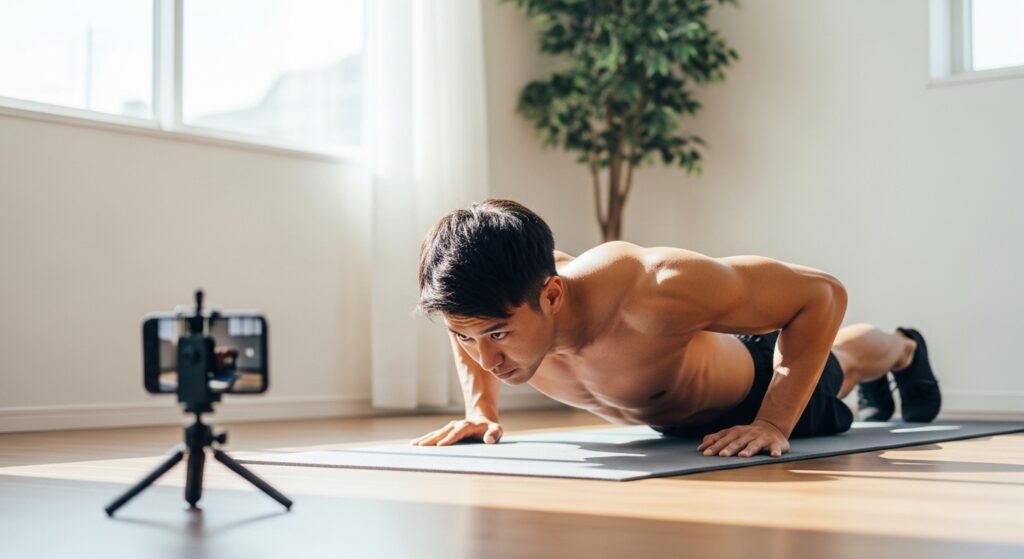
Simply activate OrionFit’s smart AI camera function, set up your smartphone horizontally, and perform the Pike Push-Up. Your home room will transform into a high-tech personal gym.
- Automatic Rep Counting with Motion Recognition:
OrionFit’s AI camera recognizes in real-time whether the pre-set joint angles have been reached. By counting only correct reps where the hips are sufficiently high and the head is lowered to the appropriate depth, ‘cheating’ (using flawed form) is completely eliminated, guaranteeing high-quality sets.
*(Note: This feature is for rep detection via camera motion analysis and does not provide precise medical form analysis or error detection.)* - ‘Scoring System’ Visualizes Angle Stability and Rhythm:
Your performance throughout the workout session (e.g., how consistently your hip angle was maintained, or if your movement rhythm was stable) is quantified with a score. Aiming to improve your score in a game-like manner maximizes motivation, allowing for continued precise training. - Further Evolution with ‘AI Personalized Advice’ in the ‘Pro Plan’:
With the paid Pro Plan, based on your recorded workout data, the AI provides specific, personalized training advice just for you. You’ll receive feedback from your smartphone, much like a dedicated trainer, such as, ‘Your hip angle tends to break down in the latter half of the set. Let’s focus on increasing your intensity for the last 3 reps next time.’
Conclusion: Master Your Home Shoulder Workout with the OrionFit App and Achieve Your Ideal ‘Melon Shoulders’!
The Pike Push-Up, performed at home, is an ultimate exercise that can provide stimulation comparable to, or even exceeding, gym machines to your deltoids, provided you maintain the correct ‘hip angle’ and ‘head descent point’.
To minimize the risk of injury and fastest achieve the admired, bulky ‘melon shoulders’, let’s leverage the latest technology.
With ‘OrionFit’, you no longer need to wonder, ‘Is my form correct?’
The AI accurately data-mines your daily efforts and pushes your motivation to its limit. Elevate your home workouts to the next level starting today with OrionFit!
Download the app now and take the first step towards your ideal V-taper body.
Download the OrionFit App and Start Training with Correct Form Today!