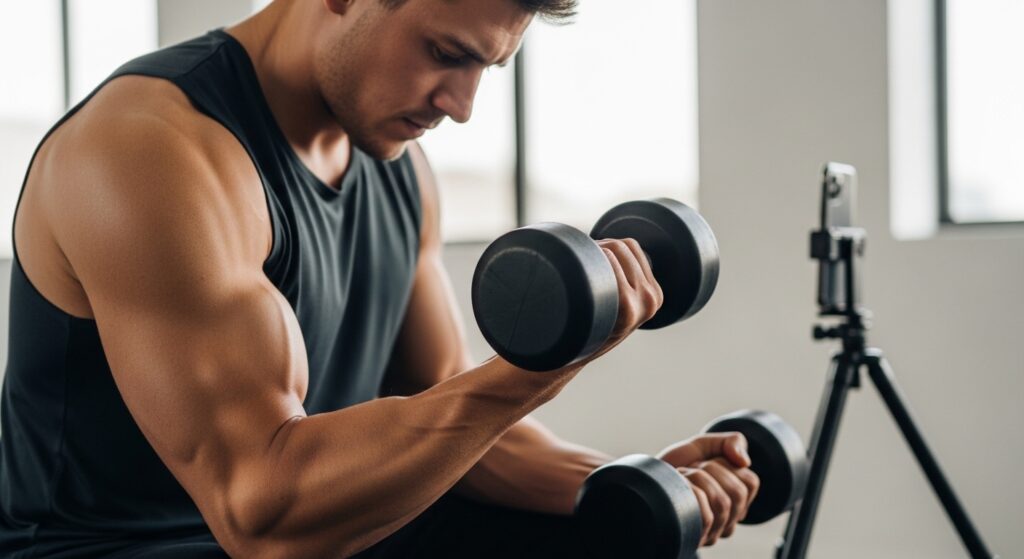
Say Goodbye to Thin Arms Peeking Through Your T-Shirt! The Importance of Forearms for a Man’s Physique
Do you find that no matter how much you train your chest or biceps, your forearms look thin and unbalanced peeking out from your sleeves? Or perhaps your grip gives out before your back during deadlifts or pull-ups, causing you to drop the bar? Many trainees face these issues, often stemming from a lack of forearm muscle mass. The forearms are highly visible in daily life and business, symbolizing masculinity and strength – they are the ‘face’ of your physique. Weak forearms can make even a well-built torso appear uninspired. Furthermore, weak forearms become a critical bottleneck in all pulling exercises. The ultimate exercise to dramatically solve this and build thick, powerful, ‘log-like’ arms is the Wrist Curl. This guide will teach you the correct way to perform wrist curls to maximize growth in your forearm flexors while completely preventing injury, and introduce a next-generation smart training method using an AI camera-equipped smartphone app to meticulously manage your movement tempo and wrist range of motion.
Why Train Your Forearms? The Hypertrophy Effects of Wrist Curls and Benefits for Heavy Lifting
You might think forearms can be trained incidentally with other exercises. However, to truly thicken your arms and boost strength output, you need isolation exercises that specifically target the forearms. The forearms consist of many small, intricate muscles, but the largest and most crucial for arm thickness are the forearm flexors: the radialis, ulnaris, superficialis, and profundus. The wrist curl directly and intensely loads these muscles by performing ‘flexion’ – bending the wrist towards the palm.
Strengthening your forearm flexors significantly enhances your grip strength. This frees you from the frustration of your grip failing before your back during deadlifts, allowing you to lift heavier weights and accelerate overall muscle growth. Furthermore, thick forearms with prominent veins (vascularity) when sleeves are rolled up instantly signal a well-trained physique, proving your dedication to observers. Complementing the peak of your biceps with thick forearms creates a perfectly proportioned arm.
【Injury Prevention】Correct Wrist Curl Form and Weight Setting for Maximum Forearm Flexor Engagement
The wrist is a delicate joint composed of numerous small bones and ligaments. Lifting heavy weights with poor form can lead to tendonitis or wrist joint pain, forcing long breaks from training. Adhere to the following rules for safe and effective training:
- Starting Position: Kneel beside a flat bench or sit on a seat, resting your forearms on the bench. Ensure your wrists extend beyond the edge of the bench.
- Grip: Hold the dumbbell or barbell with an underhand grip (palms facing up).
- Eccentric (Lowering) Phase: Slowly lower the weight by extending your wrists. Allow the dumbbell to roll down towards your fingertips to maximize range of motion and fully stretch the forearm flexors.
- Concentric (Curling) Phase: First, curl your fingers, then curl your wrist towards your face (flexion). Pause for one second at the peak contraction to intensely squeeze your forearms.
For maximum results with wrist curls, the key is ‘light weight, high reps’. Use a weight that allows you to perform 15-20 repetitions to failure. Lifting too heavy risks injury and recruits biceps or shoulder muscles, diverting the load from your target forearms. Maintain strict form by keeping your elbows firmly on the bench to prevent the load from shifting to your biceps.
Proper nutrition is also crucial. Consume protein immediately post-workout to supply amino acids for muscle synthesis. During a bulking phase, ensure adequate intake of carbohydrates to fill glycogen stores, ensuring sufficient nutrient delivery even to extremities like the forearms.
Next-Generation Smart Training: Control Wrist ROM and Negative Tempo with OrionFit App’s AI Camera
Wrist curls have a limited range of motion, making it difficult to objectively assess if you’re bending your wrist to the correct angle or maintaining the right tempo. This is where smartphone AI camera technology comes in. The fitness app ‘OrionFit’ can dramatically enhance your wrist curl quality at home or in the gym.
The AI camera feature allows you to set up your smartphone camera and monitor your wrist’s range of motion in real-time. It accurately counts repetitions only when your wrist reaches the required angles, ensuring strict training. OrionFit also manages your tempo, guiding you to ideally lower the weight over 3 seconds and lift in 1 second, maximizing Time Under Tension (TUT) for extreme hypertrophy. After each workout, you receive a score based on your performance (e.g., consistency in range of motion and tempo), which serves as strong motivation for your next session, evolving your training into a scientific endeavor.
Conclusion: Achieve Envy-Inducing Forearms with AI Technology and Perfect Form!
Thick, rock-hard forearms peeking from your sleeves are a testament to high-quality training and meticulous self-management. The wrist curl is an exceptional exercise for dramatically increasing forearm mass and grip strength, which in turn boosts your lifts in other exercises. However, achieving maximum results requires precise form that controls wrist range of motion and movement tempo.
To prevent injury and achieve thick forearms via the shortest route, why not leverage the power of cutting-edge technology? The fitness app ‘OrionFit’ uses your smartphone camera to powerfully support your smart training. Its features include AI camera rep counting (recognizing when the correct range of motion is achieved), workout scoring to visualize your progress, and (with the Pro plan) personalized AI advice based on your accumulated data. Download the app now, ditch self-taught form, and build arms that command awe!
Download the OrionFit app: Download OrionFit for free on Google Play