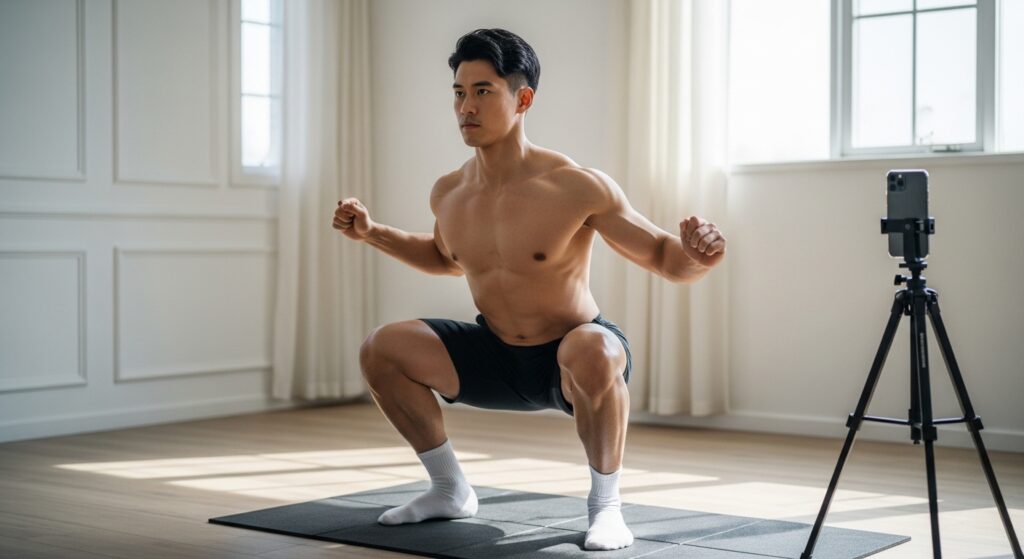
The ‘Squat Barrier’ Blocking Men’s Bulk-Up Goals
“I don’t know if I’m squatting deep enough… I’m afraid of injuring my knees.” Many men aim for a powerful lower body, wanting thicker thighs and jeans that fit a muscular physique. They try bodyweight squats or dumbbell squats at home. But often, they’re plagued by questions: “Is my form really correct?” “How deep should I go?”
Squatting too shallow won’t adequately stimulate the target muscles. Conversely, forcing yourself too deep puts excessive strain on your knee joints and lower back, risking serious injury. This fear of injury and doubt about effectiveness are the biggest hurdles to consistent lower body training at home.
The Perfect Squat is the Foundation of a Stronger Lower Body
The squat is renowned as the “King of Exercises”, considered the most crucial movement in bodybuilding. However, to maximize its benefits, it’s essential to train based on scientific, objective metrics rather than just feel. Mastering the correct squat form is the only way to completely avoid injury and build a powerful lower body in the shortest possible time.
Why the Squat is the Ultimate Muscle-Building Exercise
The ‘Biggest Trigger’ for Growth Hormone and Testosterone Release
The squat’s reputation as the ultimate muscle-building exercise isn’t just about targeting leg muscles. The lower body contains about 70% of your body’s muscles. Intensely stimulating these massive muscle groups with squats dramatically boosts the release of testosterone and growth hormone, vital for developing a masculine physique.
These anabolic hormones powerfully support muscle growth not only in your legs but also in your chest, back, and arms. Simply put, if you want to achieve full-body bulk-up quickly, skipping squats is not an option.
The Science of Muscle Growth: Targeting Quads, Hamstrings, and Glutes
The squat is a compound exercise involving multiple joints. It allows you to simultaneously place intense load on the following target areas in a single movement:
- Quadriceps (Front of Thighs): The largest muscles, symbolizing leg thickness and power.
- Hamstrings (Back of Thighs): Muscles that add thickness to your legs from the side and back.
- Glutes (Buttocks): Muscles that stabilize the pelvis and create a firm, masculine hip line.
Moving these muscles through their maximum range of motion triggers microscopic muscle damage and subsequent super-compensation, leading to formidable muscle growth.
Prevent Injury and Hit Target Muscles: The Correct Squat Form
“Knee Angle” is Key: The Line Between Parallel and Full Deep
The crucial factor for maximizing squat effectiveness and safety lies in “the degree of knee bend (squat depth).”
For optimal muscle hypertrophy, the commonly recommended depth is the “parallel squat” (where thighs are parallel to the floor, approximately 90 degrees of knee flexion) or even deeper, the “full deep squat” (where the hips sink below the knees).
Shallow squats (like quarter squats) only load the upper part of the quadriceps. To effectively stretch the entire quadriceps and glute muscles, it is extremely important to bend your knees past 90 degrees (to the point where your thighs are parallel to the floor).
3 Key Points for Injury-Free Squats (Knees & Lower Back)
No matter how much weight you lift, getting injured negates all your efforts. Burn these three points into your mind:
- Align Knees and Toes: When squatting, if your knees cave inward (knee valgus), it places abnormal stress on the outer collateral ligament and meniscus. Always ensure your “toes point slightly outward, and your knees track in the same direction as your toes.”
- Prevent Posterior Pelvic Tilt (Lower Back Rounding): Trying to squat too deep can cause your pelvis to tuck under and your lower back to round, leading to lumbar injury. Keep your chest up, maintain the natural S-curve of your spine, and the golden rule is to “hinge at the hips, pushing your glutes back as you descend.”
- Maintain Balanced Foot Pressure (Slightly Heel-Dominant): Standing on your toes puts excessive stress on the patellar tendon. Focus on pressing the ground firmly with your entire foot.
Solve It with OrionFit App’s AI Camera: The Cutting Edge of Home Smartphone Training
AI Camera Detects Knee Angle for Accurate Rep Counting
While you might understand the importance of correct squat form, it’s incredibly difficult to self-check if your knees are bending to the required 90 degrees during the movement. Looking in a mirror can alter your neck position and compromise your form.
The fitness app “OrionFit” offers a smart solution to this problem.
The innovative AI camera feature in OrionFit uses your smartphone’s camera to capture your training movements in real-time. The AI recognizes your knee bend angle and determines if you’ve reached the pre-set depth (e.g., for a parallel squat), accurately counting your reps.
This eliminates “cheated reps” from shallow squats, ensuring that every repetition effectively loads the target muscles. *Note: This feature is for motion tracking and rep counting via the camera and is not intended for precise form analysis or error detection.*
Score Your Rhythm and Angle Stability! Get AI Advice with the Pro Plan
Moreover, OrionFit is more than just a rep counter. It includes features to visualize the quality of your entire workout session.
- Workout Scoring: Analyzes the “stability of each squat’s depth” and the “consistency of your rep tempo” to score your performance. Aiming to improve your score gamifies the process, naturally leading to better form.
- Pro Plan AI Personalized Advice: For those serious about bulking up, the Pro Plan offers personalized feedback and advice from AI based on your accumulated workout data. Get specific guidance like, “Your tempo has been inconsistent lately, focus on pacing” or “Your range of motion has stabilized nicely,” creating an environment akin to having a personal trainer at home.
Conclusion: Master Correct Form with OrionFit and Build a Powerful Lower Body at Home!
You don’t necessarily need expensive gym equipment to build a strong, muscular lower body. What you need is the correct squat form and objective data to ensure you perform it consistently. Your home workouts will dramatically improve by moving beyond “just-doing-squats” and incorporating the eye of AI.
Break free from the fear of knee injury and start performing the ultimate squat that targets your muscles with 100% load, starting today. Your partner for transformative body modification, powered by cutting-edge AI technology, is here. Download the app now and take the first step towards an enviably powerful lower body!